
Boiler tube failure is one of the common problems that can cause an unexpected unit shutdown in a thermal power plant. One question often comes after a tube leakage: “Boiler pressure and temperature were within limits, so why did the tube fail?”
This question is not as simple as it looks.
A boiler tube is exposed to different conditions on its inside and outside surfaces. Water or steam flows inside the tube, while the outside is exposed to high-temperature flue gas, flame, ash, slag and in some locations, soot blower action. Because of this, a tube can gradually become weak even when the main boiler operating parameters appear normal. The failure may be caused by overheating, corrosion, erosion, fatigue, deposits, poor water chemistry, creep, welding problems or a combination of several factors.
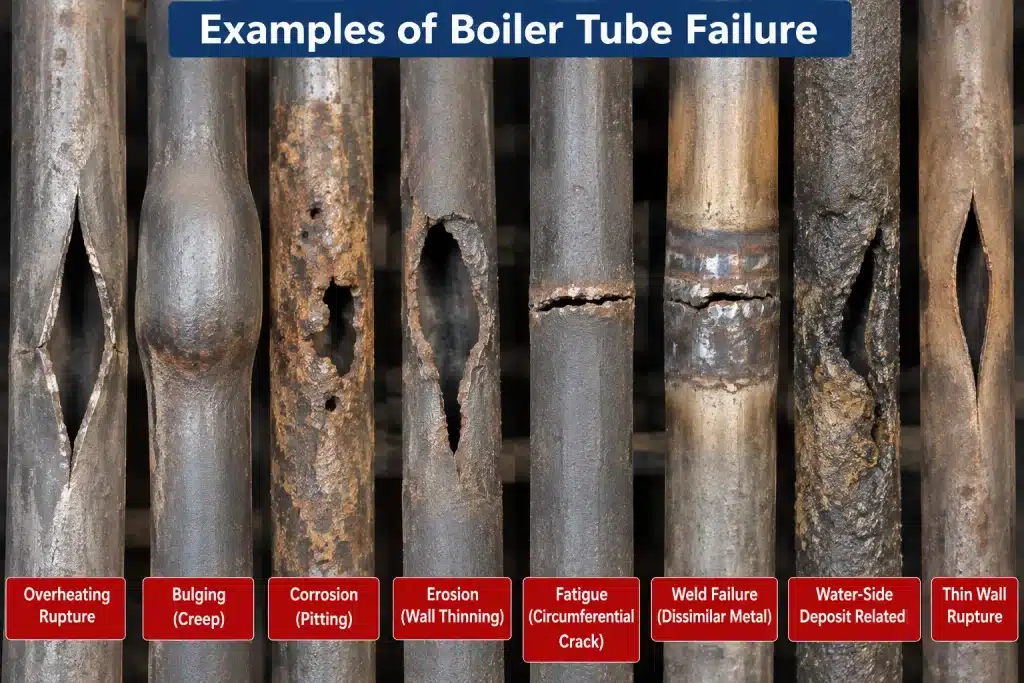
Let’s understand why this happens.
1. Normal Steam Temperature Does Not Always Mean Normal Tube Temperature
This is one of the most important points in boiler tube failure. The temperature shown in DCS is normally a measured process parameter. It does not necessarily represent the actual metal temperature at every point of every tube. A particular tube may experience a higher temperature because of:
- Restricted water or steam flow
- Internal deposits
- Poor circulation
- Uneven heat absorption
- Flame impingement
- Uneven burner operation
- Local gas-flow conditions
For example, if deposits build up inside a tube, heat transfer from the tube metal to the fluid can be affected. The tube-metal temperature may increase even though the overall steam temperature appears normal.
So we should remember:
Normal steam temperature does not always mean normal tube-metal temperature.
2. Tube Wall Thickness May Have Become Too Low
A tube can also fail because its wall has gradually become thinner. Consider a tube with an original thickness of 5 mm. If corrosion or erosion reduces the thickness to 3 mm, the tube is no longer in the same condition as a new tube. The boiler pressure may remain exactly the same, but the remaining tube wall has less strength to withstand the internal pressure. This is why tube thickness inspection is important during planned outages.
Typical inspection methods include:
- Ultrasonic thickness measurement
- Visual inspection
- NDT
- Replication and metallurgical examination where required
A tube does not necessarily fail because pressure suddenly increased.
Sometimes the pressure remained normal while the tube gradually lost its ability to withstand that pressure.
3. Water-Side Corrosion Can Damage the Tube
The inside surface of the tube is continuously exposed to water or steam. Poor water chemistry can create conditions for different types of corrosion. Some examples are:
- Oxygen pitting
- Hydrogen damage
- Caustic attack
- Under-deposit corrosion
- Acid attack
- Corrosion fatigue
A small corrosion pit may initially appear insignificant. But a deep pit creates a local weak point in the tube wall. With continued operation, the damaged area can develop into a leakage or rupture.
This is why boiler chemistry control is not only a chemistry department responsibility—it is also an important part of boiler tube reliability.
4. Deposits Inside the Tube Can Create More Than One Problem
Deposits are particularly important because they can contribute to different failure mechanisms. An internal deposit can:
- Reduce heat transfer.
- Increase local tube-metal temperature.
- Restrict water flow.
- Create local chemical concentration.
- Promote corrosion.
Therefore, when a failed tube is inspected, the deposit condition should also be checked. A tube with heavy internal deposits may have been experiencing abnormal conditions for a long time before the actual leakage occurred.
5. Fireside Corrosion Can Reduce Tube Thickness
The outside surface of a boiler tube also faces aggressive conditions. In coal-fired boilers, the tube surface can be exposed to:
- Coal ash
- Sulphur-containing combustion products
- Slag
- High-temperature deposits
- Reducing atmosphere
- Corrosive gases
Under unfavorable conditions, the protective oxide layer can deteriorate and corrosion can progress. The tube may gradually lose thickness from the fireside. Again, the boiler pressure may remain completely normal. The failure occurs because the tube has lost sufficient wall thickness at a particular location.
6. Fly Ash and Sootblower Erosion Can Remove Tube Metal
Not all tube wall loss is caused by corrosion. Erosion is another important cause. Flue gas carries ash particles at high velocity. When these particles repeatedly strike a tube surface, they can gradually remove tube material. Sootblower operation can also cause erosion if the cleaning jet repeatedly affects the same vulnerable area. Common locations of concern include:
- Economizer
- Superheater
- Reheater
- Areas near sootblowers
- High-velocity gas-flow regions
- Locations where gas direction changes
The damage may take years to develop. By the time leakage occurs, the tube may have become considerably thinner.
7. Thermal Cycling Can Cause Fatigue
A boiler does not operate at one fixed load throughout its life. It experiences:
- Start-up
- Shutdown
- Load increase
- Load reduction
- Frequent load changes
- Temperature changes
Every heating and cooling cycle causes the tube to expand and contract. If the tube is restrained by attachments or other structural arrangements, stresses can develop. Repeated cycles can eventually initiate cracks. This is known as thermal fatigue. If corrosion is also present, the damage can become more serious.
Therefore, a tube failure during today’s operation may actually be the result of damage accumulated during many previous start-ups and shutdowns.
8. Long-Term Overheating Can Lead to Creep Failure
Some tube failures develop slowly over a long period. This is particularly important for superheater and reheater tubes. When tube-metal temperature remains higher than desirable for a long time, the material can gradually undergo creep damage. Possible reasons include:
- Restricted steam flow
- Internal deposits
- Excessive heat input
- Uneven burner operation
- Poor gas-flow distribution
- Local overheating
The tube may continue operating for a long period before finally developing a rupture. Therefore, checking only today’s temperature is not always enough. It is also important to understand the temperature history of the tube throughout its service life.
9. Short-Term Overheating Can Cause Sudden Failure
Long-term overheating is a gradual process. Short-term overheating can be much faster. If a tube suddenly loses adequate cooling, its metal temperature can rise rapidly. Possible causes include:
- Flow blockage
- Restricted circulation
- Improper start-up
- Loss of steam flow
- Excessive heat input
- Abnormal operating conditions
The tube may become severely overheated and rupture. In many cases, the failure occurs before the operator has enough time to recognize the problem from normal plant indications.
10. Welding or Material Problems Can Also Cause Failure
Sometimes the main cause is not boiler operation. The problem may be associated with:
- Incorrect material
- Welding defects
- Improper welding procedure
- Heat-affected zone problems
- Dissimilar metal welds
- Fabrication defects
- Improper repair
A repaired tube may therefore fail again if the underlying repair or welding problem has not been corrected. This is why simply replacing the failed portion of tube is not always a permanent solution.
What Should Be Done After a Boiler Tube Failure?
Replacing the failed tube is only the immediate action. The more important question is: Why did the tube fail?
A proper investigation should include:
1. Check the failure location
Identify whether the tube belongs to Waterwall, Economizer, Superheater, Reheater, Header, Welded connection, Attachment area.
2. Examine the failed portion
Look for Wall thinning, Pitting, Bulging, Cracks, Erosion marks, Internal deposits, External deposits, Abnormal rupture appearance.
3. Check tube thickness around the failure
Do not inspect only the failed location. Nearby tubes should also be checked if the same failure mechanism could affect them.
4. Review operating history
Check Boiler load, Start-ups, Shutdowns, Temperature trends, Burner operation, Sootblower operation, Water chemistry, Previous tube leakage, Maintenance history.
5. Identify the actual failure mechanism
The final objective should be to determine whether the failure was caused by:
Overheating + creep + corrosion + erosion + fatigue + material/welding problem + operating condition
or a combination of these.
Different failure mechanisms require different corrective actions. Industry guidance also emphasizes determining the failure mechanism and root cause rather than simply replacing the failed tube.
How Can Boiler Tube Failures Be Prevented?
There is no single solution for every tube failure. A practical prevention approach includes:
- Maintain proper boiler water chemistry.
- Control deposits and scale.
- Monitor tube wall thickness.
- Inspect erosion-prone locations.
- Check sootblower performance.
- Maintain proper combustion and burner alignment.
- Avoid flame impingement.
- Follow proper start-up and shutdown procedures.
- Monitor load cycling.
- Inspect welds and repaired locations.
- Use the correct tube material.
- Investigate repeated tube failures.
- Perform metallurgical examination when required.
- Take corrective action based on the actual failure mechanism.
Conclusion
A boiler tube can fail even when the boiler pressure and temperature shown by the plant instruments are within their normal operating limits.
The reason is simple:
Boiler tube failure is a local and cumulative problem, while many operating parameters are measured as overall process conditions.
A tube can be affected by:
Overheating → Creep → Corrosion → Erosion → Fatigue → Deposits → Poor chemistry → Welding/material problems
and several mechanisms can sometimes act together. Therefore, after a boiler tube failure, the correct question is not only: “Were the boiler pressure and temperature normal?” The better question is: “What mechanism weakened this particular tube, and what was the root cause?”
Finding that answer is the key to preventing the next tube failure.