
Sootblowers are essential equipment in thermal power plants. They remove ash, soot and slag deposits from the gas-side surfaces of boiler tubes and help maintain proper heat transfer.
However, sootblowing can also become a source of tube damage when the equipment is misaligned, operated at excessive pressure, affected by condensate or used more frequently than necessary. This type of tube wastage is commonly known as sootblower erosion.
The damage may start as localized surface wear and gradually develop into significant wall thinning and tube failure. In some cases, erosion can also work together with corrosion after the protective oxide layer is removed.
What Is Sootblower Erosion and How Does It Damage Boiler Tubes?
Sootblower erosion is the progressive loss of tube metal caused by repeated impact from the sootblowing medium and particles carried with it. Sootblowers may use:
- Superheated steam
- Saturated steam
- Compressed air
- Water
- Combinations of cleaning media
The purpose of sootblowing is to remove deposits that create additional thermal resistance on the tube surface. Excessive deposits can reduce heat transfer and boiler efficiency. But repeated and unnecessarily aggressive cleaning can damage the tube surface.
Basic damage mechanism of sootblower erosion:
Sootblower Jet → Repeated Impact → Surface Metal Loss → Wall Thinning → Reduced Tube Strength → Tube Failure
The amount of erosion depends on factors such as impact velocity, impact angle, material properties and the characteristics of the impacting particles or fluid.
Erosion-corrosion can also occur
Sootblowing does not only remove deposits. Excessive cleaning can also remove the protective oxide layer from the tube surface. Once this protective layer is removed, the exposed metal can become more susceptible to corrosion, allowing erosion and corrosion to contribute together to tube wastage.
Frequent Sootblowing → Protective Oxide Removal → Exposed Tube Surface → Erosion + Corrosion → Increased Metal Wastage
Therefore, the objective should not be maximum sootblowing. It should be optimized sootblowing.
What Causes Sootblower Erosion?
Several operating and maintenance conditions can increase the risk of sootblower-related tube damage.
1. Sootblower Misalignment
A misaligned sootblower can direct the cleaning jet toward an unintended tube area. Repeated impact on the same location can produce localized metal loss and wall thinning.
Misaligned Sootblower → Incorrect Jet Direction → Repeated Local Impact → Metal Loss → Tube Thinning
The damage pattern can therefore provide an important clue during failure investigation.
2. Excessive blowing pressure
Higher sootblower pressure generally produces higher nozzle exit velocity. Higher velocity means greater impact energy and can increase the erosion rate.
Therefore:
Higher Blowing Pressure → Higher Exit Velocity → Higher Impact Energy → Higher Erosion Potential
Sootblower pressure should be maintained within the designed operating range rather than increased unnecessarily.
3. Condensate in the sootblowing medium
Condensate is one of the important hidden causes of sootblower erosion. Condensation can occur because of:
- Poor drainage
- Temperature variations
- Insufficient steam superheat
- Improper moisture-trap operation
- Inadequate warm-up of the system
If water enters the sootblowing medium, high-velocity water droplets can produce significant impact damage because water is much denser than steam or air.
Poor Drainage / Insufficient Superheat → Condensate Formation → Water Enters Sootblower → High-Velocity Droplet Impact → Increased Tube Erosion
Condensate can also produce thermal shock at the tube surface and contribute to thermal-fatigue cracking.
4. Excessive sootblowing frequency
Sootblowing is necessary, but cleaning the tubes more frequently than required can increase tube wastage. Repeated cleaning can remove the protective oxide layer and contribute to erosion-corrosion. Determining an optimum sootblowing period based on actual ash buildup rather than simply following a fixed once-per-shift or once-per-day schedule.
5. Improper sootblower location or malfunction
Incorrect installation, mechanical problems or malfunction can change the actual direction and characteristics of the cleaning jet. Following as major root-cause influences:
- Incorrect blowing temperature
- Condensate
- Improper moisture-trap operation
- Excessive pressure
- Improper sootblower location
- Misalignment
- Sootblower malfunction
- Excessive sootblowing
Where Does Sootblower Erosion Occur and What Does It Look Like?
Sootblower erosion can occur on different boiler heating surfaces depending on the sootblower arrangement.
Common locations include:
- Waterwall tubes
- Superheater tubes
- Reheater tubes
- Economizer tubes
- Tube areas directly exposed to the blower path
- Tubes adjacent to sootblower openings
The erosion pattern is strongly influenced by the direction of the sootblower jet. 1d96add0-16b1-4193-b795-625cbc0…
What does the damage look like?
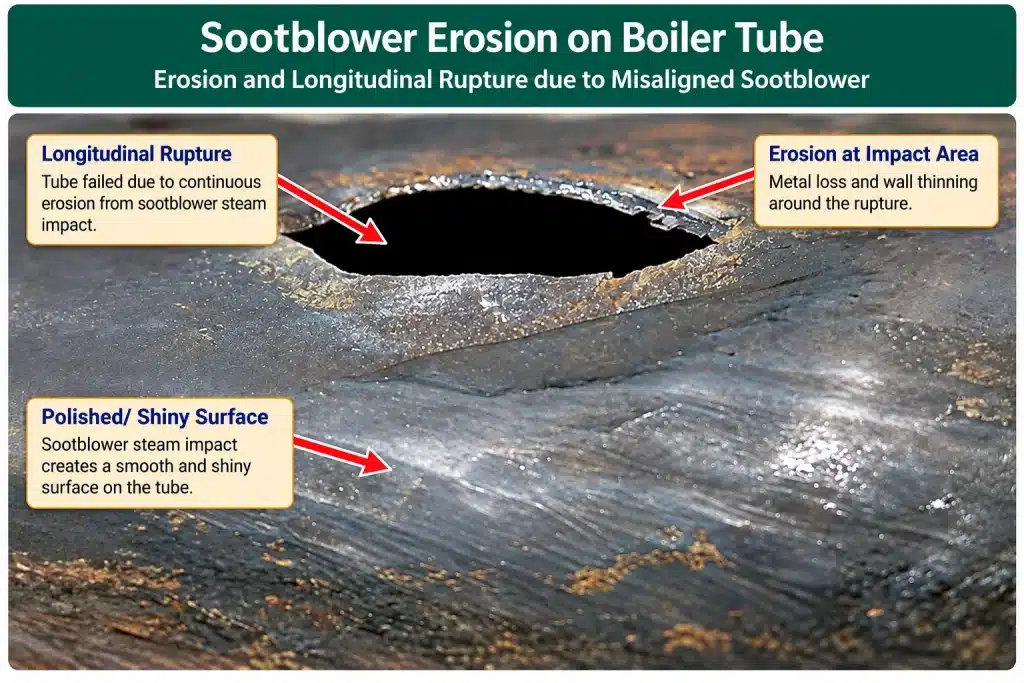
Typical signs can include:
- Localized surface wastage: The damage may be concentrated around the area exposed to the sootblower.
- Polished or worn surface: Repeated impact can produce a smooth, polished or visibly worn tube surface.
- Flattened area: Heavy wastage can create relatively flat areas on the tube surface. The source identifies flat areas as an indication of significant tube wastage.
- Wall thinning: As erosion continues, the remaining tube wall becomes thinner.
- Rust after boiler washing: Fresh rust appearing within a short period after boiler washing can indicate that the protective oxide layer has been removed.
- Tube rupture: If the remaining wall thickness becomes insufficient to withstand internal pressure, the tube can eventually fail.
- Damage progression:
Repeated Sootblower Impact → Local Metal Loss → Surface Wastage → Wall Thinning → Reduced Pressure-Carrying Thickness → Tube Rupture
How Can Sootblower Erosion Be Identified?
A proper investigation should combine visual inspection, thickness measurement and sootblower operating checks.
Visual examination
During an outage, inspect tubes around the sootblower path for:
- Localized wastage
- Polished or worn surfaces
- Flat areas
- Gouges
- Rust after boiler washing
- Damage corresponding to the blower direction
Visual examination can identify serious sootblower erosion and provide clues about the source of the damage.
Ultrasonic thickness measurement
Visual inspection alone cannot determine the actual remaining wall thickness. Ultrasonic Testing (UT) can be used to identify wall thinning and determine the extent of damage. This information helps engineers decide whether repair or replacement is necessary.
Check the sootblower
After identifying the damaged area, inspect the corresponding sootblower.
- Alignment
- Blowing pressure
- Blowing temperature
- Moisture traps
- Drains
- Travel time
- Rotation
- Sequence
- Mechanical condition
- Cleaning frequency
Practical investigation sequence
Failure Location → Visual Examination → Damage Pattern → UT Thickness Measurement → Sootblower Alignment → Pressure & Temperature → Condensate/Trap Condition → Travel & Rotation → Cleaning Frequency → Root Cause
This approach is much more useful than simply replacing the failed tube.
How Can Sootblower Erosion Be Prevented?
Prevention requires attention to both sootblower equipment and operating practices.
1. Maintain correct alignment
Inspect the sootblower position, lance and nozzle alignment regularly. Alignment problems can develop because of mechanical forces encountered during operation and can be identified by inspection during planned outages.
2. Control blowing pressure
Avoid unnecessarily high pressure. Higher velocity increases the potential for erosion.
3. Keep condensate out of the system
Regularly check:
- Steam traps
- Drains
- Drain valves
- Warm-up arrangements
- Steam superheat
- Insulation and heat tracing where applicable
Proper warm-up and drainage of supply piping to reduce condensate entering the sootblowing system.
4. Maintain proper steam condition
Insufficient superheat can promote condensation. Blowing temperature should therefore be checked along with pressure.
5. Avoid unnecessary sootblowing
Sootblowing frequency should be adjusted according to actual ash/deposit buildup and boiler operating conditions. Instead of following a fixed once-per-shift or once-per-day schedule, the sootblowing interval should be optimized based on the actual cleaning requirement.
6. Calibrate and test sootblowers
Periodically verify:
- Pressure
- Temperature
- Travel
- Rotation
- Sequence
- Moisture-trap operation
- Mechanical condition
Regular calibration and testing can help identify problems before they cause repeated tube failures.
7. Monitor tube wall thickness
Where previous erosion has occurred, UT measurements can be used to monitor the condition of affected tubes.
8. Correct the root cause after a failure
Replacing only the failed tube is not enough if the sootblower problem remains.
Tube Replacement → Same Sootblower Problem → Continued Erosion → Repeat Tube Failure
The sootblower condition must therefore be corrected along with the tube repair.
Key Points to Remember
- Sootblowers are necessary for removing boiler deposits and maintaining heat transfer.
- Incorrect sootblower operation can cause tube erosion.
- Misalignment can concentrate the cleaning jet on a local tube area.
- Excessive pressure increases impact velocity and erosion potential.
- Condensate can significantly increase impact damage.
- Excessive sootblowing can remove the protective oxide layer.
- Typical signs include localized wastage, polished surfaces, flat areas and wall thinning.
- Visual inspection helps identify the damage pattern.
- UT helps determine actual wall-thickness reduction.
- Alignment, pressure, temperature, traps, drains, travel and rotation should be checked during investigation.
- Sootblowing frequency should be optimized according to actual cleaning requirements.
- Correcting the root cause is essential to prevent repeat failures.
Conclusion
Sootblowers play an important role in maintaining boiler heat-transfer surfaces, but improper operation and maintenance can cause significant tube wastage. The main factors include misalignment, excessive pressure, condensate, insufficient steam superheat, excessive sootblowing frequency and equipment malfunction.
The damage can progress gradually:
Sootblower Impact → Surface Wastage → Wall Thinning → Reduced Tube Strength → Tube Failure
Early visual inspection, UT thickness measurement and proper sootblower checks can help identify the problem before it develops into a serious tube failure. The goal is therefore not maximum sootblowing, but optimized sootblowing with correct alignment, pressure, cleaning frequency and proper steam/air condition.