
Increasing boiler steam temperature is one of the most effective ways to improve the thermal efficiency of a coal-fired power plant.
So, a natural question arises:
If higher steam temperature improves efficiency, why don’t we simply keep increasing it?
The answer is that a boiler is not limited by thermodynamics alone.
As steam temperature and pressure increase, the operating conditions of boiler tubes, headers, pipes and other pressure parts become increasingly severe. Creep, oxidation, corrosion, thermal fatigue, material strength, fabrication requirements and cost all become important.
Therefore, the real engineering challenge is not simply to achieve the highest possible steam temperature.
It is to achieve higher efficiency while maintaining component reliability, service life and economic viability.
Why Does Higher Steam Temperature Improve Boiler Efficiency?
A coal-fired power plant converts the chemical energy in coal into electrical energy through a thermodynamic cycle. The more effectively the plant converts the energy released from fuel into electricity, the higher the overall efficiency. Steam temperature and pressure play an important role in this process. When higher-temperature steam enters the turbine, the thermodynamic performance of the Rankine cycle can improve. This is one of the reasons boiler technology has progressed through:
Subcritical → Supercritical → Ultra-Supercritical → Advanced Ultra-Supercritical
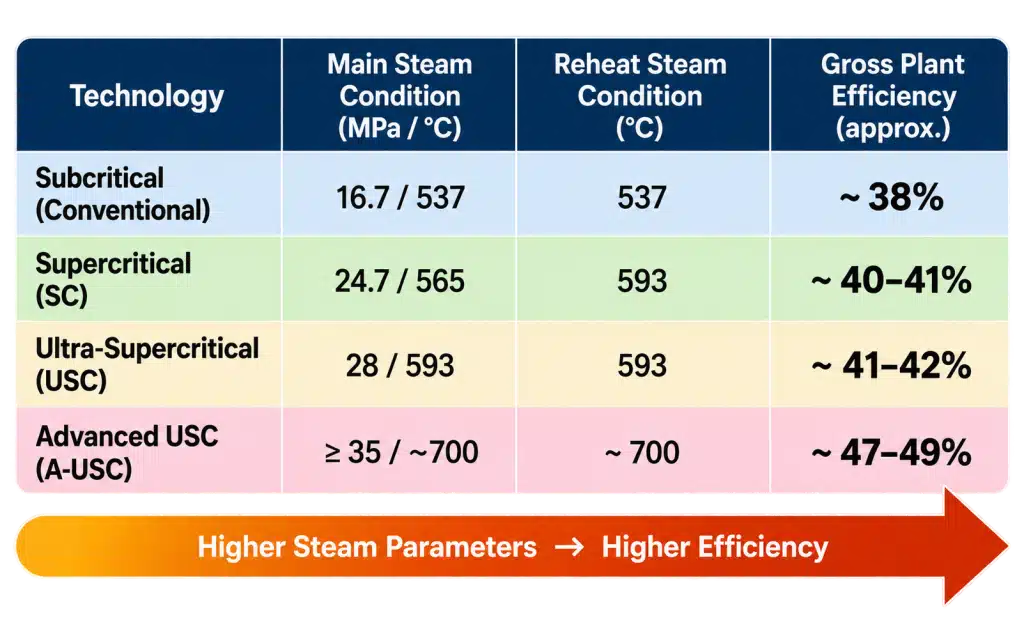
The objective is straightforward: Extract more electrical energy from the same amount of fuel. Higher efficiency can also reduce the amount of fuel required for a given electrical output and can contribute to lower emissions and resource consumption.
But there is a major engineering limitation.
The Problem: The Boiler Material Has a Limit
The thermodynamic cycle may benefit from higher steam temperature, but the boiler pressure parts must physically survive the conditions.
As temperature increases, engineers must consider properties such as:
- Creep strength
- Creep rupture strength
- Allowable stress
- Maximum service temperature
- High-temperature oxidation
- Corrosion
- Thermal fatigue
- Welding and fabrication
- Inspection and maintenance
- Material cost
This is where the problem becomes more complicated.
A material that performs well at one temperature may not provide adequate long-term reliability at a significantly higher temperature.
Problem 1: Creep Becomes a Major Concern
One of the most important limitations of high-temperature boiler operation is creep. Creep is the gradual deformation of a material when it remains under stress at elevated temperature for a long period. Boiler tubes operate under a combination of:
High temperature + internal pressure + mechanical stress + long operating duration
This combination makes creep particularly important. A tube does not have to fail immediately for creep to become a problem. Over thousands of operating hours, creep can result in:
- Permanent deformation
- Tube swelling
- Loss of dimensional stability
- Reduction in remaining life
- Crack development
- Eventual tube failure
This is why high-temperature boiler materials must be evaluated for long-term creep and creep-rupture performance, rather than only their short-term strength.
Problem 2: Conventional Materials Cannot Be Used Indefinitely
As steam conditions increase, the material requirements also change. Materials commonly used for conventional boiler applications cannot simply be extended indefinitely into higher-temperature service.
For example, low-alloy steels such as T11 and T12 have limitations when exposed to increasingly severe high-temperature conditions. As the temperature requirement increases, materials such as: T23 / T24 → T91 / T92 → Advanced Austenitic Steels → Nickel-Based Alloys become increasingly important depending on the component and design conditions.
The important principle is:
A boiler material must retain sufficient strength and resistance throughout the entire expected service life—not just during initial operation.
Problem 3: Higher Temperature Also Increases Oxidation Risk
Creep is not the only problem. As temperature increases, oxidation of the steam-side surface and corrosion-related damage can become increasingly important. This is particularly significant in high-temperature superheater and reheater sections. A material therefore cannot be selected only because it has good creep strength. Engineers need to consider the combination of:
Creep strength + oxidation resistance + corrosion resistance + thermal stability + fabrication capability + cost
This is why material selection for high-temperature boiler components is an engineering optimization problem.
Problem 4: The Waterwall Itself Can Face Different Requirements
Increasing steam conditions can change the thermal duty of different boiler components. In a conventional subcritical boiler, waterwalls primarily perform the evaporation function. In supercritical once-through boilers, the heat-transfer process is different because there is no conventional steam drum separating water and steam. As the steam conditions increase, portions of the waterwall system can experience different thermal duties and some areas can be exposed to more demanding temperature conditions.
Therefore, increasing steam parameters is not simply a matter of changing the main steam temperature set point. The heat-transfer design, tube-metal temperature and material selection must all be considered together.
Problem 5: Why Not Use the Most Expensive Alloy Everywhere?
At first glance, there seems to be a simple solution. If conventional steels cannot withstand very high temperatures, why not use the most advanced alloy throughout the boiler?
The problem is cost and practicality. The progression toward higher-temperature materials generally moves through different material families: Low-alloy steels → Ferritic/martensitic steels → Austenitic steels → Nickel-based alloys
Using the highest-cost alloy everywhere would not necessarily be an economical engineering solution. The better approach is: Use the right material in the right location.
Problem 6: What Happens Around 700°C?
The challenge becomes even more significant when moving toward Advanced Ultra-Supercritical (A-USC) conditions. At temperatures approaching the 700°C range, conventional boiler materials can reach their practical limits. The final-stage superheater and reheater components become particularly challenging because the tube-metal temperature can become significantly higher than the surrounding design assumptions might suggest.
At these temperatures, advanced austenitic materials may no longer provide sufficient long-term capability for every application. This is where nickel-based alloys become increasingly important. Materials such as nickel-based high-temperature alloys can provide much greater temperature capability, but they also introduce:
- Higher material cost
- More demanding fabrication
- Welding considerations
- Inspection requirements
- Specialized manufacturing requirements
Therefore, reaching approximately 700°C is not simply a boiler-control problem. It is a materials, design, manufacturing and operational challenge
Problem 7: Steam Temperature Is Not the Same as Tube-Metal Temperature
This is an important point that is sometimes overlooked. When we say that a boiler operates at a particular main steam temperature, that does not mean every pressure-part surface is operating at exactly the same temperature. Local heat-transfer conditions can create differences between:
Steam temperature ↔ Tube-metal temperature
Tube-metal temperature can be influenced by:
- Heat flux
- Gas-side temperature
- Steam flow
- Tube arrangement
- Fouling
- Slagging
- Local flow distribution
- Attemperation
- Operating conditions
Therefore, simply looking at the main steam temperature is not enough to understand the actual thermal stress on a pressure part. For high-temperature components, tube-metal temperature management becomes extremely important.
Problem 8: Thermal Cycling Also Matters
A boiler does not always operate at one constant load. Modern plants may experience:
- Startup
- Shutdown
- Load changes
- Frequent ramping
- Minimum-load operation
- Cycling operation
Repeated temperature changes can produce thermal expansion and contraction. Over time, this can contribute to thermal fatigue. The problem becomes particularly important around:
- Headers
- Superheater tubes
- Reheater tubes
- Thick-walled components
- Welded joints
- High-temperature piping
Therefore, material selection must consider not only steady-state temperature but also the plant’s actual operating pattern.
Problem 9: Fabrication and Welding Become More Important
Selecting a high-performance material is only one part of the engineering process. The material must also be:
- Manufactured
- Formed
- Welded
- Heat-treated where required
- Inspected
- Installed
- Maintained
Some advanced ferritic/martensitic steels require careful welding procedures and post-weld heat treatment. Advanced alloys can also introduce their own fabrication challenges. Therefore: Material capability alone does not guarantee component reliability. The complete manufacturing and installation process must be compatible with the selected material.
So What Is the Solution?
The answer is not to stop increasing steam temperature. Higher steam parameters can provide significant efficiency benefits. The practical solution is to increase steam temperature and pressure in a controlled and optimized manner, while ensuring that the boiler materials and components can safely withstand the conditions.
1. Optimize Steam Parameters
Do not automatically target the highest possible temperature. Instead, select steam conditions based on:
- Required efficiency
- Plant design
- Reliability
- Component life
- Material availability
- Capital cost
- Lifecycle cost
The objective should be:
Maximum practical value—not maximum temperature.
2. Use the Right Material in the Right Location
Different parts of the boiler experience different temperatures and stresses. Therefore, the entire boiler does not necessarily need the same material. A practical material strategy can progress from conventional steels to more advanced alloys as service temperature and component requirements increase.The principle is simple:
Don’t use an expensive material where it is unnecessary, but don’t use an inadequate material where component life is at risk.
3. Control Tube Metal Temperature
One of the most important practical considerations is the actual temperature of the pressure-part metal. Main steam temperature alone does not tell the complete story. High-temperature sections such as:
- Final superheater
- Reheater
- Platen superheater
- Headers
- Main steam piping
- Hot reheat piping
require careful thermal design and operational control. The objective is to avoid local overheating and maintain sufficient material-life margin.
4. Monitor Creep and Other Degradation
High-temperature boiler components should be managed throughout their service life. Important degradation mechanisms to monitor include:
- Creep deformation
- Oxidation
- Corrosion
- Wall-thickness reduction
- Cracking
- Thermal fatigue
- Abnormal tube temperature
The objective is to identify degradation before it becomes a tube failure or forced outage.
This turns high-temperature operation from a simple design problem into a lifecycle management problem.
5. Use Advanced Materials Selectively
Advanced materials should be used where their additional capability provides real engineering value. For the most demanding high-temperature applications, nickel-based alloys can provide the temperature capability required for USC/A-USC conditions. But using them everywhere may not be economically justified.
Therefore:
Use advanced alloys where the temperature and stress demand them, not simply because they have the highest temperature capability.
6. Consider Lifecycle Cost, Not Just Initial Cost
A cheaper material is not always the cheaper engineering solution. Similarly, the most expensive alloy is not automatically the best solution.
Engineers should consider: Initial material cost, Fabrication cost, Inspection cost, Maintenance cost, Failure/outage risk, Expected component life, Lifecycle Cost
Conclusion
So, why can’t we simply increase boiler steam temperature to improve efficiency?
Because there is no unlimited free efficiency gain.
Higher steam temperature can improve the thermodynamic efficiency of a coal-fired power plant, but it also increases the demands placed on boiler materials and components.
At progressively higher temperatures, creep becomes more important. Oxidation and corrosion become more challenging. Thermal cycling can introduce fatigue. Conventional materials eventually become inadequate, requiring advanced ferritic/martensitic steels, austenitic steels and, for the most demanding conditions, nickel-based alloys.
These materials can increase fabrication complexity and cost. Therefore, the practical solution is not to reject higher steam temperatures. It is to optimize them.
The most effective strategy is to:
Select the optimum steam parameters → use the right material in the right location → control tube-metal temperature → monitor degradation → manage component life → evaluate lifecycle cost.
The goal is not to build the boiler capable of operating at the highest possible temperature.
The goal is to achieve the highest practical efficiency while maintaining safety, reliability, component life and economic viability.
That is the real engineering challenge behind high-temperature boiler technology.