
Boiler tube failure is one of the common causes of forced outages in thermal power plants. Among the different damage mechanisms, hydrogen damage can be difficult to detect because much of the damage develops inside the tube material.
Unlike ordinary corrosion or overheating, the outside of the tube may not show significant deformation before failure. Small cracks and internal damage may develop inside the tube material over time, reducing the strength of the tube until failure occurs.
This article explains boiler tube hydrogen damage, how it develops, what causes it, how to identify it and how it can be prevented in plant operation.
What Is Boiler Tube Hydrogen Damage?
Boiler tube hydrogen damage occurs when atomic hydrogen generated during an internal corrosion reaction enters the steel and causes internal damage. It is generally associated with high-temperature, high-pressure boiler conditions and deposits on the internal surface of the tube. The hydrogen can enter the steel and accumulate at defects, inclusions or grain boundaries. It can also react with cementite in the steel and form methane. As hydrogen or methane accumulates, internal cracks or microcracks can develop. With continued damage, these cracks can join together and reduce the strength of the tube.
A simplified sequence of boiler tube hydrogen damage is:
Under-deposit corrosion → Atomic hydrogen generation → Hydrogen enters steel → Methane/hydrogen accumulation → Microcracks → Loss of strength → Tube failure
Why Does Boiler Tube Hydrogen Damage Occur?
Hydrogen damage is strongly associated with under-deposit corrosion. When deposits build up on the internal surface of a boiler tube, they can create a localized environment where corrosion reactions take place. These reactions can produce atomic hydrogen.
A simplified reaction can be represented as:
Fe + H₂O → FeO + 2H
The atomic hydrogen can then enter the steel instead of immediately escaping from the tube surface. This is why internal deposits are important when investigating a suspected hydrogen-damage failure. A clean tube surface is generally less susceptible than a tube having heavy or hard deposits.
How Does Hydrogen Enter the Tube Material?
The process can be understood step by step.
Step 1: Deposits Form: Deposits accumulate on the water-side surface of the boiler tube.
Step 2: Localized Corrosion Develops: The environment beneath the deposit can become favorable for localized corrosion.
Step 3: Atomic Hydrogen Is Produced: The corrosion reaction produces hydrogen in atomic form.
Step 4: Hydrogen Enters the Steel: Some of the atomic hydrogen diffuses into the tube material.
Step 5: Hydrogen Accumulates: Hydrogen can collect at locations such as voids, inclusions and grain boundaries.
Step 6: Internal Cracking Develops: The accumulated hydrogen can create high local pressure and contribute to the formation of small cracks and microcracks.
The important point is that the damage is developing inside the tube material, so external inspection alone may not reveal the full extent of the problem.
How Does Methane Formation Cause Further Damage?
Hydrogen damage can become more serious when atomic hydrogen reacts with cementite (Fe₃C) present in the steel.
The reaction can be represented as:
4H + Fe₃C → 3Fe + CH₄
The methane formed inside the steel cannot easily escape. It can accumulate near grain boundaries and create internal pressure. At the same time, the reaction consumes carbon from the steel. This process is known as decarburization.
The combined effect can weaken the material and produce internal Small Cracks and microcracks.
How Does Hydrogen Damage Cause Boiler Tube Failure?
The complete failure process can be represented as:
Under-Deposit Corrosion → Atomic Hydrogen Formation → Hydrogen Diffusion into Steel → Methane Formation / Hydrogen Accumulation → Decarburization → Microvoids and Small Cracks → Microcracks → Loss of Tube Strength → Brittle Tube Rupture
The major damage develops internally. Therefore, the tube may not show the large bulging normally associated with severe overheating. As the internal small cracks grow and join together, the effective strength of the tube decreases. Eventually, the remaining sound material may not be able to withstand the internal pressure, resulting in tube rupture.
What Does a Hydrogen-Damaged Boiler Tube Look Like?
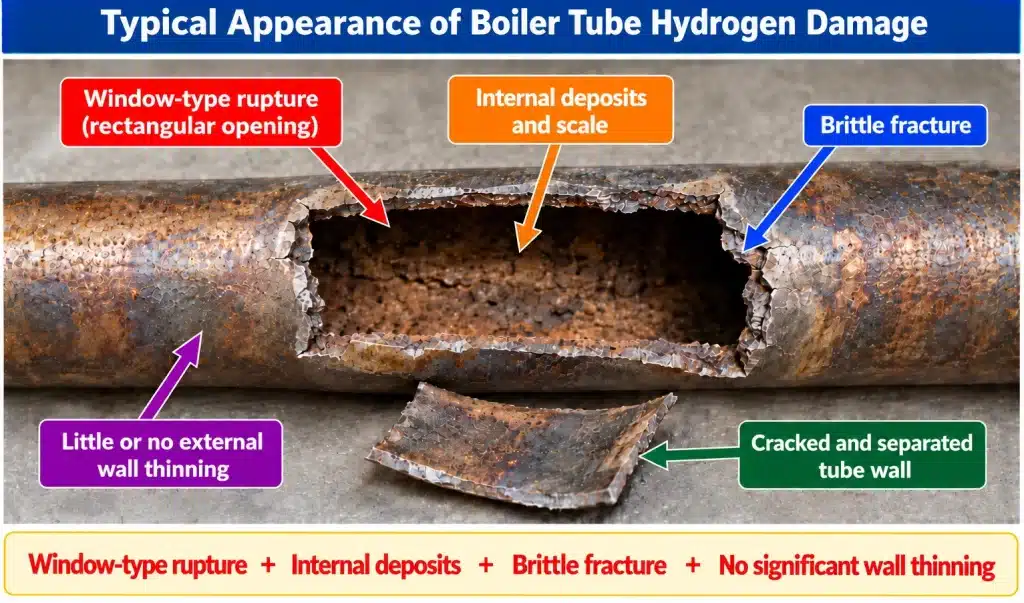
One of the important characteristics of hydrogen damage is a window-type rupture. A relatively large rectangular section of the tube wall can separate from the tube, producing an appearance similar to a window. Typical observations may include:
- Window-type or rectangular opening
- Brittle-looking fracture
- Little or no wall-thickness reduction at the fracture
- Damage initiating from the internal surface
- Internal deposits or scale
- Intergranular fissures
- Microcracks inside the material
- Decarburization
- Microvoids associated with the damaged microstructure
These features should be considered together rather than using one feature alone to identify hydrogen damage.
Where Is Hydrogen Damage More Likely to Occur?
Hydrogen damage is particularly associated with locations where deposits, high heat flux and localized corrosion can develop. Potentially affected areas include:
- Waterwall tubes
- High-heat-flux regions
- Upper burner areas
- Horizontal or inclined tubes
- Areas near welds
- Locations with heavy internal deposits
- Areas affected by poor chemical cleaning
Hydrogen damage can also be associated with metal gouging beneath porous deposits, which is an important point during failure investigation.
What Is the Role of Boiler Water Chemistry?
Boiler water chemistry plays an important role in controlling the conditions that can lead to hydrogen damage. Hydrogen damage can occur under low-pH as well as high-pH conditions when localized corrosion produces atomic hydrogen.
For example, condenser cooling-water leakage or an acidic excursion can create conditions favorable for hydrogen generation. Excessive deposits and poor chemical cleaning can also increase susceptibility. Therefore, maintaining the required boiler-water chemistry and controlling internal deposits are important parts of prevention.
How Can Boiler Tube Hydrogen Damage Be Identified?
Hydrogen damage should not be diagnosed only by looking at the outside of the failed tube. A proper investigation should consider several factors.
1. Visual Examination
Check for:
- Window-type rupture
- Fracture appearance
- Internal deposits
- Failure location
- Evidence of thinning or gouging
2. Fracture Examination
A brittle fracture with cracking originating from the internal surface can be an important indication of hydrogen damage.
3. Metallographic Examination
Microscopic examination can reveal:
- Fissures
- Microcracks
- Microvoids
- Intergranular cracking
- Pearlite degradation
- Decarburization
4. Deposit and Scale Examination
Internal deposits should be examined because under-deposit corrosion can be closely associated with hydrogen generation.
5. Chemical Analysis
Analysis of deposits and corrosion products can help determine whether the local environment was capable of producing hydrogen damage.
Hydrogen Damage vs Hydrogen Embrittlement
Hydrogen damage and hydrogen embrittlement are sometimes confused, but they are different mechanisms. Hydrogen damage or hydrogen attack in boiler tubes is associated with high-temperature, high-pressure service conditions and internal corrosion reactions.
Hydrogen embrittlement, on the other hand, is a different mechanism generally associated with hydrogen entering metals under conditions closer to room temperature.
Therefore, these two mechanisms should not be treated as the same boiler tube failure mechanism.
Why Is Hydrogen Damage Dangerous?
The major concern with hydrogen damage is that the damage can develop inside the tube material. The tube may not show the large bulging normally associated with severe overheating. Instead, microscopic cracks can gradually reduce the effective strength of the material.
As these cracks grow and join together, the tube becomes less capable of carrying the internal pressure. Eventually, the remaining sound section may not be sufficient to withstand the operating pressure, resulting in a sudden rupture.
How Can Boiler Tube Hydrogen Damage Be Prevented?
Prevention should focus on controlling the conditions that produce under-deposit corrosion and hydrogen generation.
1. Maintain Proper Boiler Water Chemistry
Maintain the required chemistry parameters within the plant’s specified operating limits.
2. Control Internal Deposits
Heavy deposits can create localized corrosion conditions. Regular monitoring and appropriate cleaning practices can help reduce this risk.
3. Prevent Condenser Cooling-Water Contamination
Cooling-water leakage can affect boiler-water chemistry and create conditions favorable for hydrogen damage.
4. Maintain Proper Circulation
Poor circulation can increase local heat flux and promote deposit-related damage in susceptible areas.
5. Monitor High-Risk Locations
Waterwalls near high-heat-flux regions, burner areas, bends, weld regions and locations with repeated tube failures should receive particular attention.
6. Investigate Repeated Tube Failures
If several failures occur in the same area, simply replacing the tube may not solve the problem.
The deposit condition, water chemistry, tube material and operating conditions should also be investigated.
7. Follow Proper Chemical Cleaning Practices
Improper cleaning can contribute to deposits and localized corrosion. Cleaning procedures should therefore be properly controlled and followed according to the boiler condition and plant procedure.
Practical Failure Investigation Sequence
When hydrogen damage is suspected, the investigation can follow this sequence:
Failure Location → Internal Deposits → Tube Wall Condition → Fracture Examination → Metallography → Microcrack Examination → Decarburization Check → Deposit/Chemical Analysis → Operating & Chemistry History → Root Cause
This approach helps distinguish hydrogen damage from other boiler tube failure mechanisms such as overheating, erosion and conventional corrosion.
Conclusion
Hydrogen damage is a serious water-side mechanism that can cause boiler tube failure even when the damage is not obvious from the outside.
The process is closely associated with under-deposit corrosion and the generation of atomic hydrogen. Hydrogen can enter the steel and either accumulate internally or react with cementite to form methane. This can result in decarburization, fissuring, microcracking and progressive loss of tube strength.
A window-type brittle rupture, internal deposits, fissures, microcracks and decarburization are important clues during a failure investigation.
Proper boiler water chemistry, deposit control, circulation, chemical cleaning and regular inspection are important for reducing the risk of hydrogen damage and preventing repeated boiler tube failures.
Related Boiler Tube Failure Articles :
Boiler Tube Failure: Why Do Tubes Fail Even When Pressure and Temperature Are Normal?
Short-Term Boiler Tube Overheating: Causes, Failure Mechanism and Prevention
Long-Term Boiler Tube Overheating: Causes, Creep Mechanism & Prevention