
A generator cannot produce electrical power simply by rotating its rotor. The rotor must first have a magnetic field. This magnetic field is created by supplying electrical current to the rotor field winding. The system that supplies, controls and regulates this field current is called the Generator Excitation System.
In a large thermal power plant, the excitation system is an important part of the generator because it controls the magnetic field required for generator operation. One commonly used arrangement is the Static Excitation System, which uses a transformer, thyristor rectifier, AVR and other electrical equipment to provide controlled excitation to the generator.
What Is a Generator Excitation System?
A generator excitation system is the system used to supply controlled electrical current to the field winding of a synchronous generator.
The excitation system performs several important functions:
- Establishes the magnetic field of the rotor.
- Controls generator terminal voltage.
- Controls or influences reactive power.
- Provides a means of increasing or decreasing field current.
- Supports stable generator operation.
- Provides protection and limiting functions during abnormal operating conditions.
The excitation system continuously monitors generator electrical parameters and adjusts the field current according to the required operating condition.
Basic Elements of a Generator Excitation System
A typical excitation system contains several functional elements:
1. Excitation Source
The excitation source provides the electrical power required for the generator field. Depending on the excitation arrangement, this power may come from a DC exciter, AC exciter, generator terminals, or an auxiliary electrical source.
2. Automatic Voltage Regulator (AVR)
The Automatic Voltage Regulator (AVR) compares the actual generator voltage with the reference voltage and controls excitation accordingly.
3. Voltage and Current Measurement
Voltage transformers, current transformers and other measuring devices provide feedback signals to the excitation control system.
4. Rectifier or Converter
Where AC is used as the excitation power source, a rectifier converts AC into controlled DC required by the generator field.
5. Field Circuit
The field circuit carries the excitation current to the generator rotor field winding.
6. Limiters and Protection
Limiters and protection functions prevent excessive field current, over-excitation, under-excitation and other abnormal operating conditions.
7. Power System Stabilizer
A Power System Stabilizer (PSS) can provide an additional control signal to improve the dynamic stability of the generator and power system.
Types of Generator Excitation Systems
Generator excitation systems can broadly be classified according to the source and arrangement of excitation power.
The main types are:
- DC Excitation System
- AC Excitation System
- Static Excitation System
The static excitation system can itself be arranged in three different configurations:
- Potential-Source Controlled Rectifier System
- Compound-Source Rectifier System
- Compound-Controlled Rectifier System
DC Excitation System
In a DC excitation system, a DC generator is used as the source of excitation power. The DC exciter is generally mechanically coupled to the turbine-generator shaft. The output of the exciter is supplied to the main generator field through slip rings.
DC excitation systems were used extensively in earlier generator installations. Modern large generating units generally use more advanced excitation arrangements.
AC Excitation System
In an AC excitation system, an AC machine or alternator is used as the excitation source. The AC output of the exciter is converted into DC using a rectifier. Depending on the design, the rectifier can be stationary or rotating.
A major development of AC excitation is the brushless excitation system, where rotating rectifiers can supply DC to the main generator field without the conventional main-field slip-ring arrangement.
Static Excitation System
In a Static Excitation System, the excitation equipment is stationary. There is no rotating exciter supplying the main generator field. The DC excitation current is supplied directly to the main generator rotor field through slip rings. Excitation power can be obtained from the generator terminals or from an auxiliary electrical source, depending on the system design.
A typical static excitation system includes:
- Excitation transformer
- Thyristor controlled rectifier
- Automatic Voltage Regulator
- Voltage and current measuring circuits
- Field circuit breaker
- Field flashing circuit
- Field suppression/de-excitation equipment
- Limiters and protection
Types of Static Excitation Systems
Static excitation systems can be arranged in different ways depending on how excitation power is obtained and how the excitation output is controlled.
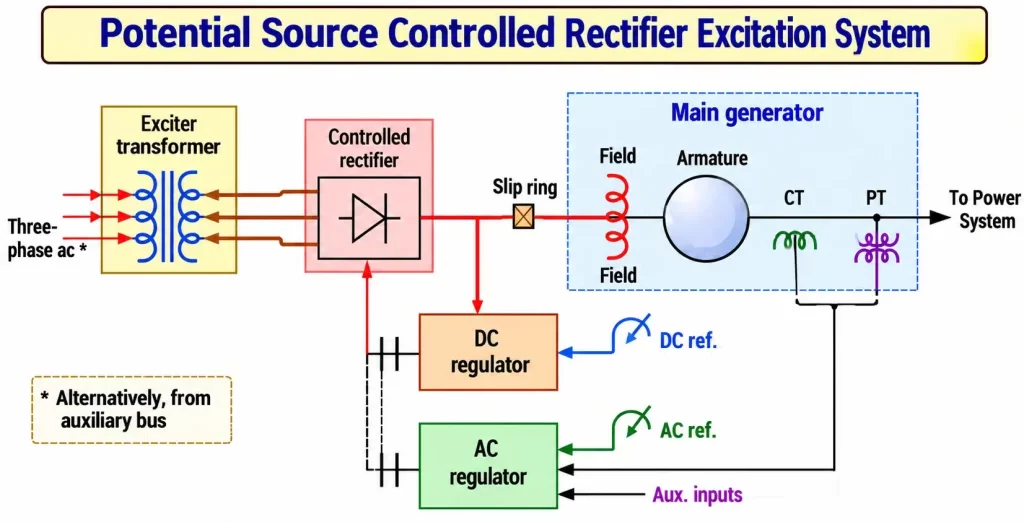
1. Potential-Source Controlled Rectifier Excitation System
In this arrangement, excitation power is obtained from the generator terminals through an excitation transformer. The transformer supplies the required voltage to a controlled rectifier, and the rectifier provides controlled DC excitation to the generator field.
This arrangement is also known as a bus-fed or transformer-fed static excitation system. It has a very small inherent time constant, allowing the excitation system to respond rapidly to changes in generator operating conditions. pdf-static-excitation-system-in…
Basic arrangement
Generator → Excitation Transformer → Controlled Thyristor Rectifier → Field Circuit → Generator Rotor Field
The AVR controls the thyristor firing angle according to the required excitation.
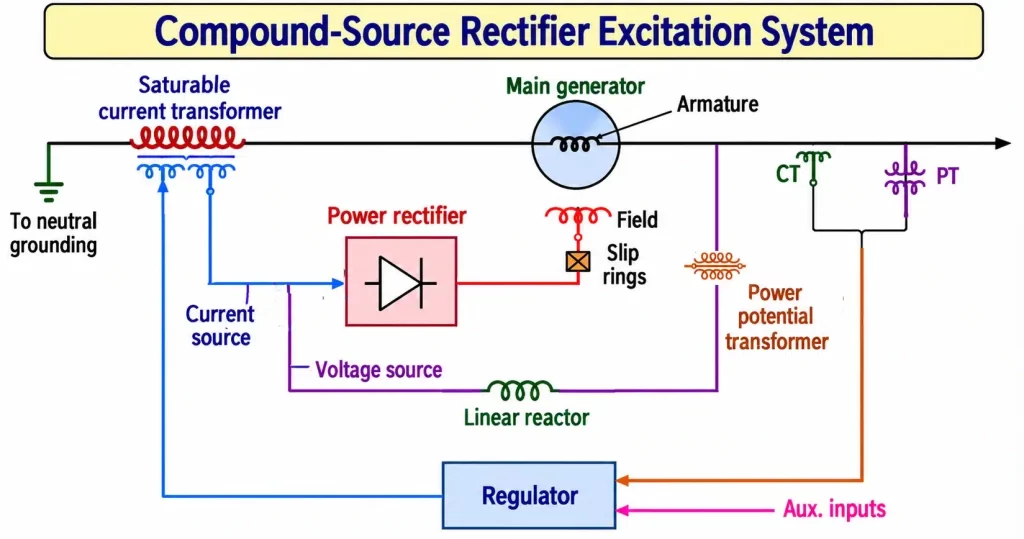
2. Compound-Source Rectifier Excitation System
In a compound-source system, excitation power is obtained using both the voltage and current of the main generator. The system uses components such as a Power Potential Transformer (PPT) and Saturable Current Transformer (SCT) to obtain the required excitation source.
An important advantage of this arrangement is its ability to maintain high field-forcing capability during a system fault. When generator voltage decreases during a fault, the current contribution can help provide excitation power.
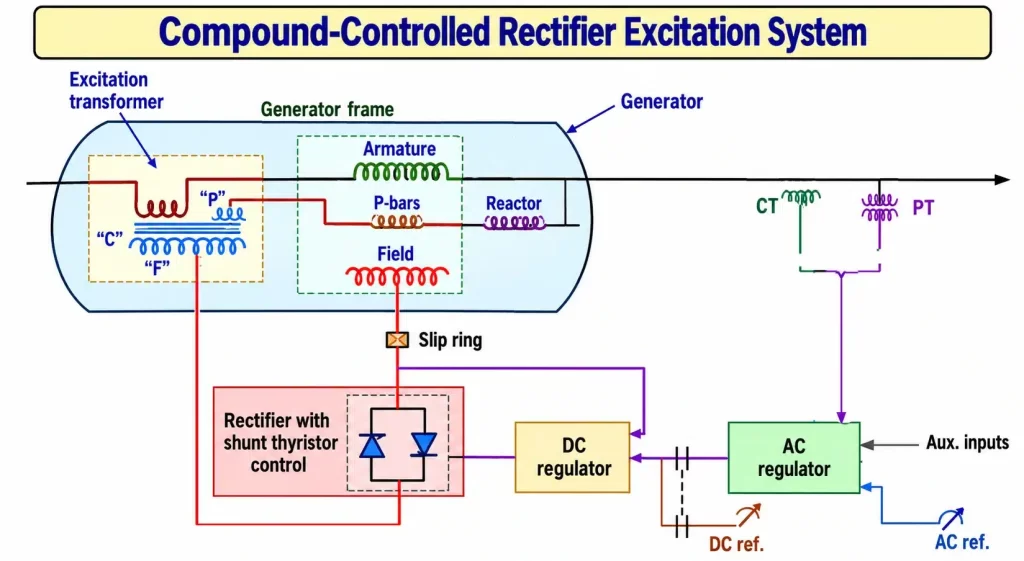
3. Compound-Controlled Rectifier Excitation System
The compound-controlled rectifier system combines controlled rectifiers with voltage-and-current compounding within the generator stator circuit. This arrangement provides a high initial response and strong fault-on field-forcing capability.
The controlled rectifier regulates the excitation output, while the compounding arrangement provides the required excitation support under changing generator and system conditions.
Main Components of a Static Excitation System
1. Excitation Transformer
The excitation transformer supplies electrical power required by the static excitation system. It receives power from the generator electrical circuit and supplies the required voltage to the thyristor rectifier. Exact rating, voltage, current, cooling and construction depend on the generator and excitation-system design.
2. Thyristor Rectifier
The thyristor rectifier is one of the most important components of a static excitation system. It converts AC power into controlled DC power for the generator field. Unlike an uncontrolled diode rectifier, the output of a thyristor converter can be controlled by changing the firing angle of the thyristors.
The AVR provides the firing control signal according to the required generator excitation.
3. Automatic Voltage Regulator (AVR)
The AVR controls the generator excitation automatically. It compares the actual generator terminal voltage with the reference or set-point voltage.
When generator voltage is low:
AVR → increases excitation → increases rotor magnetic field → generator voltage increases
When generator voltage is high:
AVR → reduces excitation → reduces rotor magnetic field → generator voltage decreases
This continuous feedback action allows the generator terminal voltage to remain close to the required value.
4. Voltage Transformer (VT)
A voltage transformer provides a suitable voltage signal from the generator terminal circuit to the excitation control system. The AVR uses this feedback signal to determine the actual generator terminal voltage. The AVR then compares the measured voltage with the reference value and generates the required control signal.
5. Field Circuit Breaker
The field circuit breaker is used to connect or disconnect the generator field circuit. It forms an important part of the excitation system because the generator field must be safely connected during excitation and disconnected during shutdown or abnormal conditions. Depending on the system design, field switching and suppression arrangements can be located on the appropriate side of the excitation circuit.
6. Field Flashing Circuit
During generator starting, the generator may not initially have sufficient terminal voltage to establish normal excitation. A field flashing circuit can provide the initial excitation energy required to build up the generator magnetic field. Once generator voltage and the excitation system are established, normal excitation can take over.
7. Field Suppression / De-Excitation
The generator rotor field winding stores electromagnetic energy. When excitation needs to be removed rapidly, simply opening the field circuit is not sufficient because the stored magnetic energy must be safely dissipated. A field suppression or de-excitation arrangement provides a controlled path for this energy. Depending on the design, it may include:
- Field breaker
- Suppression resistor
- Crowbar/thyristor arrangement
- Triggering circuit
The purpose is to remove the field safely and rapidly when required.
8. Field Current Regulator
The excitation system also monitors and controls field current. Field-current control is important because the generator field winding has limits on the amount of current that can be safely carried. The field-current regulator and associated limiters help maintain excitation within the permitted operating range.
9. Limiters and Protection
A modern excitation system includes various limiting and protection functions. These may include:
- Over-excitation limiting
- Under-excitation limiting
- Field-current limiting
- Overcurrent protection
- Field circuit protection
- Thyristor protection
- Generator protection interface
The exact protection and limiter functions depend on the excitation-system design.
10. Power System Stabilizer (PSS)
A Power System Stabilizer (PSS) provides an additional control signal to the excitation system. Its purpose is to improve the dynamic stability of the generator and power system, particularly during disturbances. It works along with the AVR rather than replacing the AVR.
Static Excitation System – Main Working Principle
Although the three static excitation arrangements differ in how their excitation power is obtained, the basic purpose is the same: to provide controlled DC current to the generator rotor field. A typical transformer-fed static excitation system works as follows:
Step 1: Generator Starts and Initial Excitation Is Established
When the turbine-generator starts rotating, the generator initially has only a small residual voltage due to residual magnetism in the generator magnetic circuit. This residual voltage is not sufficient for normal excitation operation. Therefore, the field flashing circuit provides the initial excitation current to the generator field. The initial field current strengthens the rotor magnetic field, which helps the generator terminal voltage to build up.
Step 2: Excitation Transformer Supplies the Thyristor Converter
As the generator terminal voltage builds up, the excitation transformer receives power from the generator terminals and supplies the required voltage to the thyristor converter.
Step 3: Thyristor Rectifier Converts AC to Controlled DC
The thyristor converter converts the AC supplied by the excitation transformer into controlled DC field current.
Step 4: DC Excitation Is Supplied to the Rotor
The controlled DC current passes through the field circuit and slip rings to the generator rotor field winding. This establishes the required rotor magnetic field.
Step 5: AVR Takes Automatic Control
Once the excitation system is ready for normal operation, the AVR continuously regulates the generator terminal voltage by controlling the thyristor firing and therefore the field current.
How Does Excitation Affect Reactive Power?
Excitation also has an important relationship with the reactive-power operating condition of a synchronous generator. Changing the generator field current changes the internal magnetic field of the machine and therefore affects the generator’s reactive-power behavior.
Therefore, the excitation system is not only used for voltage regulation; it also plays an important role in controlling the generator’s reactive-power operating condition.
Maintenance of Static Excitation System
Regular maintenance is important for reliable excitation-system operation. Important checks include:
- Inspecting excitation panels and electrical connections.
- Checking thyristor converter condition.
- Checking cooling and ventilation.
- Inspecting field circuit connections.
- Checking excitation-transformer condition.
- Checking temperature-monitoring systems.
- Checking AVR and control circuits.
- Checking protection and alarm functions.
- Checking field flashing and suppression circuits.
- Checking grounding connections.
- Cleaning dust and foreign material from equipment.
Maintenance should always follow the equipment manufacturer’s instructions and approved plant procedures.
Conclusion
The generator excitation system is essential for establishing and controlling the magnetic field of a synchronous generator. Among the different excitation arrangements, the Static Excitation System uses stationary electrical equipment to convert and control excitation power and supply DC directly to the generator field through slip rings.
Static excitation systems can be arranged as potential-source controlled rectifier, compound-source rectifier, or compound-controlled rectifier systems, depending on how excitation power is obtained and controlled. pdf-static-excitation-system-in…
The excitation transformer, thyristor rectifier, AVR, field circuit breaker, field flashing circuit and field suppression equipment work together to provide reliable generator excitation and voltage control. For a thermal power plant engineer, understanding the excitation system is important because its operation directly affects generator voltage, field current, reactive-power operation and overall generator stability.