
Introduction
A thermal power plant uses steam to produce power in a turbine. At first, it may appear that the process should be simple:
Boiler → Steam → Turbine → Power
If steam can expand through a turbine and produce shaft work, then why not continue this process and avoid the condenser and pump? The answer is that a thermal power plant needs a continuous and practical cycle. After expansion in the turbine, the steam must be returned to the boiler so that it can again receive heat and produce work.
This is where the Rankine cycle becomes important. A steam power plant operates as a closed-cycle plant, with steam as the working fluid, and the basic vapor power cycle is the Rankine cycle.
What Is the Rankine Cycle?
The basic Rankine cycle consists of four main processes:
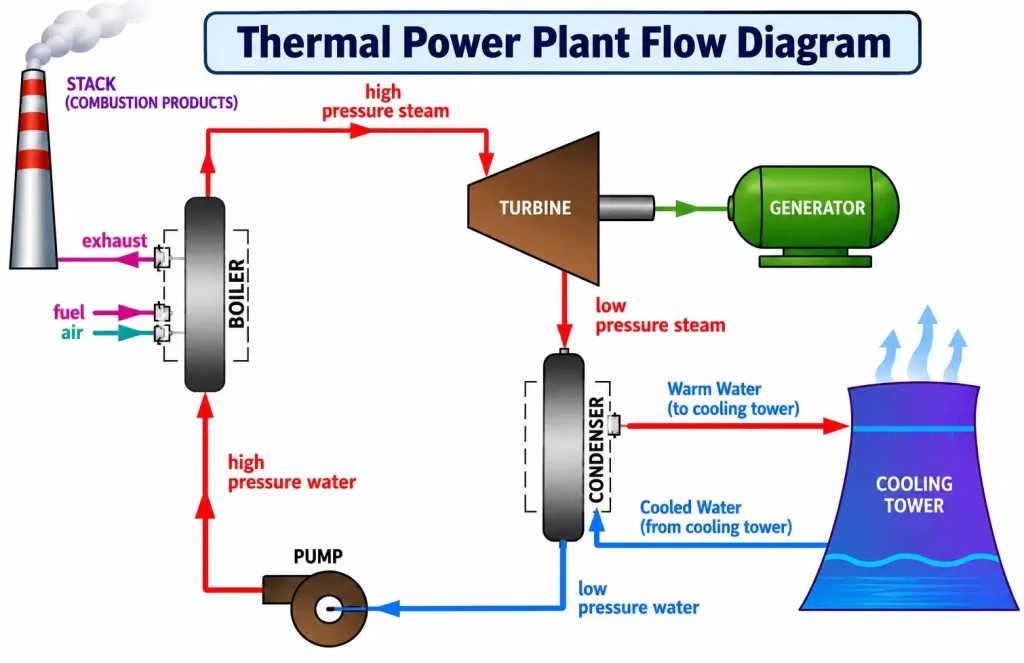
Pump → Boiler → Turbine → Condenser → Pump
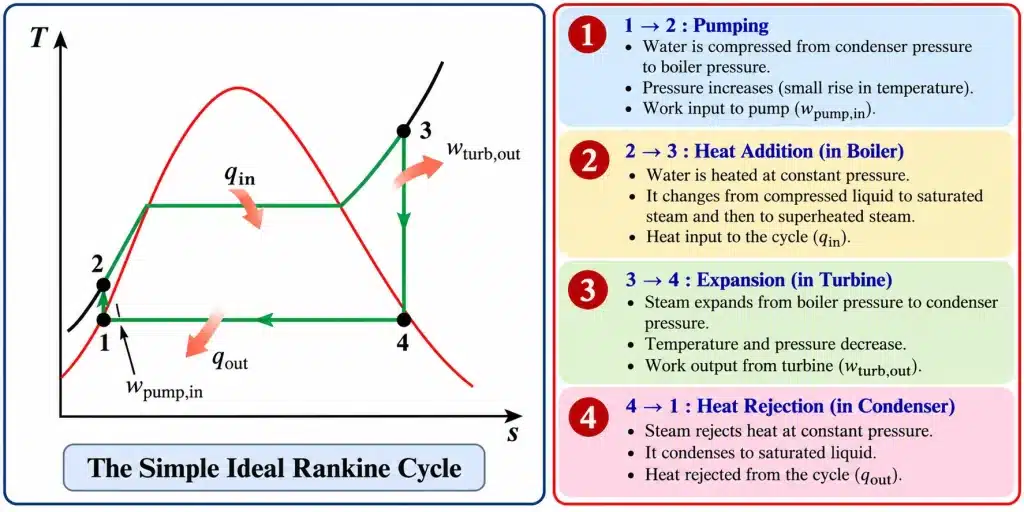
The ideal Rankine cycle consists of:
- Isentropic compression in the pump
- Constant-pressure heat addition in the boiler
- Isentropic expansion in the turbine
- Constant-pressure heat rejection in the condenser
So, the turbine is only one part of the complete cycle. The purpose of the complete arrangement is to continuously convert heat supplied to the working fluid into useful net work.
Why Not Simply Expand Steam Through the Turbine?
The main reason is simple:
Steam cannot keep expanding through the turbine indefinitely and still return to the boiler at the required condition.
When high-pressure, high-temperature steam enters the turbine, it expands and produces shaft work. During expansion:
High-Pressure Steam → Turbine Expansion → Lower Pressure & Temperature → Turbine Work
The pressure and temperature of the steam decrease during expansion. At the turbine exit, the steam can become a liquid-vapor mixture and then enters the condenser. Therefore, after producing work, the steam needs another process before it can be supplied back to the boiler. That process is condensation followed by pumping.
What Happens After the Turbine?
After expansion, the steam enters the condenser. In the condenser, heat is rejected to a cooling medium and the steam is converted into liquid water. The condensate then enters the pump, which raises its pressure to the boiler operating pressure. The complete sequence becomes:
Boiler → Turbine → Condenser → Pump → Boiler
This is what allows the same working fluid to circulate repeatedly.
Why Is the Condenser Necessary?
The condenser performs an important function in the Rankine cycle. After the turbine, the steam is at a much lower pressure. Instead of trying to compress this low-pressure steam back to boiler pressure, the Rankine cycle first converts it into liquid water.
The advantage is that liquid water requires relatively little work to be pumped to a high pressure. This is one of the key reasons the Rankine cycle is practical.
In simple terms:
Low-pressure Steam → Condensation → Liquid Water → Pump → High-Pressure Water
Instead of trying to compress a large amount of low-pressure steam, the plant condenses it and then pumps the liquid.
Why Is Pump Work Much Smaller Than Turbine Work?
This is an important point in understanding the Rankine cycle. The pump handles water in the liquid state. Liquid water has a very small specific volume, so the work required to increase its pressure is relatively small. The turbine, on the other hand, handles high-energy steam. Its expansion produces a much larger amount of work.
Therefore:
Pump Work << Turbine Work
For this reason:
Net Work = Turbine Work − Pump Work
and because pump work is usually much smaller:
Net Work ≈ Turbine Work
What Is the Role of the Boiler?
The boiler supplies heat to the water. Water leaving the pump enters the boiler at high pressure. Heat is then added at approximately constant pressure, converting the water into steam and, in a typical cycle, superheated steam.
The process can be represented as:
High-Pressure Water → Heat Addition in Boiler → High-Pressure Steam
The steam then enters the turbine. Therefore, the boiler is the heat addition section of the Rankine cycle.
What Is the Role of the Turbine?
The turbine is the main power-producing component. Superheated steam enters the turbine and expands. As the steam pressure and temperature fall, its energy is converted into mechanical work by rotating the turbine shaft. The turbine shaft is connected to an electrical generator, which converts the mechanical work into electrical power.
The basic process is:
High-Pressure Steam → Expansion in Turbine → Shaft Work → Generator → Electricity
What Is the Role of the Condenser in Power Generation?
The condenser may appear to be only a heat-rejection device, but it also helps the turbine produce more useful work. The condenser operates at a low exhaust pressure. Reducing condenser pressure can increase the work obtained from the cycle and therefore improve Rankine-cycle efficiency.
However, there is a limitation. If condenser pressure is reduced too much, the steam quality at the turbine exit decreases and moisture content increases. Higher moisture can increase erosion of turbine blades. So, condenser pressure is an important operating parameter.
Why Does the Rankine Cycle Improve Practical Steam Power Generation?
The Rankine cycle provides a practical way to combine four different functions:
Pump → Raises Water Pressure
Boiler → Adds Heat
Turbine → Produces Work
Condenser → Rejects Heat and Returns Steam to Liquid
Together they create a continuous cycle:
Water → Pump → Boiler → Steam → Turbine → Condenser → Water → Pump
In a practical thermal power plant, make-up water is added when required to compensate for water losses and maintain the required water inventory. The condensate and feedwater then circulate through the cycle again. This cycle can operate continuously as long as sufficient heat is supplied to the boiler, adequate cooling is available in the condenser, and water losses are compensated for by adding make-up water when required.
Why Is Steam Superheated Before Entering the Turbine?
Superheating the steam provides an important benefit. Increasing the steam temperature at the turbine inlet increases the Rankine-cycle efficiency. It also increases the steam quality at the turbine exit, meaning less moisture is present and less turbine-blade erosion is expected. Therefore, the actual plant does not simply send saturated steam directly into the turbine whenever higher-temperature steam can be produced safely.
The process becomes:
Feedwater → Boiler → Superheater → Superheated Steam → Turbine
Why Are Reheat and Regeneration Used?
The basic Rankine cycle can also be modified to improve performance.
Reheat
Steam can be partially expanded in the turbine, returned for reheating, and then expanded again in the next turbine stage.
HP Turbine → Reheater → LP Turbine → Condenser
Reheating can improve cycle efficiency, increase net power output and improve the quality of steam leaving the turbine.
Regeneration
Some steam can be extracted from the turbine and used to heat feedwater before it enters the boiler.
Turbine Extraction Steam → Feedwater Heater → Heated Feedwater → Boiler
This reduces the heat that must be added in the boiler to raise the feedwater to the required condition and improves Rankine-cycle efficiency. This is why large thermal power plants normally use more advanced versions of the basic Rankine cycle rather than only the simple four-component arrangement.
Why Is the Rankine Cycle Suitable for a Thermal Power Plant?
The biggest advantage is that it provides a practical method of repeatedly using water and steam as the working fluid. The cycle separates the major functions:
Heat Addition → Expansion → Heat Rejection → Pressure Increase
This allows the plant to:
- Add a large amount of heat in the boiler.
- Expand high-energy steam through the turbine.
- Convert the expansion energy into electrical power.
- Condense the exhaust steam.
- Pump the condensate back to boiler pressure.
- Repeat the process continuously.
The Simple Answer
If someone asks:
“Why doesn’t a thermal power plant simply expand steam through a turbine?”
The simplest answer is:
Because turbine expansion alone produces work but does not provide a practical way to return the low-pressure exhaust steam to the boiler. The Rankine cycle condenses the exhaust steam into water and uses a pump to raise its pressure again. This makes continuous steam circulation possible while keeping pump work much smaller than turbine work.
So the actual power-generation process is:
Heat Addition → Steam Expansion → Power Generation → Condensation → Pumping → Heat Addition
That is the basic reason the thermal power plant uses the Rankine cycle.
Practical Thermal Power Plant View
In an actual thermal power plant, the Rankine cycle is represented by many pieces of equipment rather than only four simple blocks.
A simplified flow is:
Boiler → Superheater → HP Turbine → Reheater → IP/LP Turbine → Condenser → CEP → Feedwater System → BFP → Economizer → Boiler
Additional systems such as feedwater heaters, deaerator, reheater and regenerative extraction are used to improve the overall performance of the cycle.
The basic principle, however, remains the same:
Add Heat → Expand Steam → Reject Heat → Pump Water → Repeat
Conclusion
A thermal power plant does not use the turbine alone because steam expansion is only the power-producing part of the process. A complete and continuous steam power plant requires the steam to be condensed after expansion and the resulting water to be pumped back to boiler pressure.
The Rankine cycle provides this complete arrangement:
Pump → Boiler → Turbine → Condenser → Pump
The turbine produces the major portion of the work, while the pump requires comparatively little work. This makes the cycle practical for continuous power generation. For this reason, the Rankine cycle forms the basic thermodynamic cycle behind conventional steam power plants.