
Boiler tube failure is one of the most serious problems in a thermal power plant. A small tube leak can quickly develop into a major boiler outage if it is not detected and controlled. One important failure mechanism is short-term overheating.
Unlike long-term overheating, which develops over a long period and is generally associated with creep damage, short-term overheating can damage a boiler tube very quickly. A tube can lose its strength, bulge, thin down and finally rupture when the tube metal temperature rises sharply while adequate water or steam cooling is not available.
This type of failure is commonly associated with waterwall, superheater and reheater tubes.
What is Short-Term Overheating?
Short-term overheating occurs when the metal temperature of a boiler tube rises rapidly to a level at which the tube can no longer safely withstand the internal pressure. The important point is that the problem is not simply “high temperature.” The tube normally operates under two important conditions:
- High temperature from the furnace or flue gas
- Internal cooling from water or steam flow
If the internal flow is reduced or stopped while the external heat input continues, the tube metal temperature can rise rapidly. The sequence can be:
Loss of cooling → rapid temperature rise → reduction in tube strength → bulging → wall thinning → rupture
This is why a tube can fail even though the boiler pressure itself has not suddenly increased.
What Does a Short-Term Boiler Tube Overheating Failure Look Like?
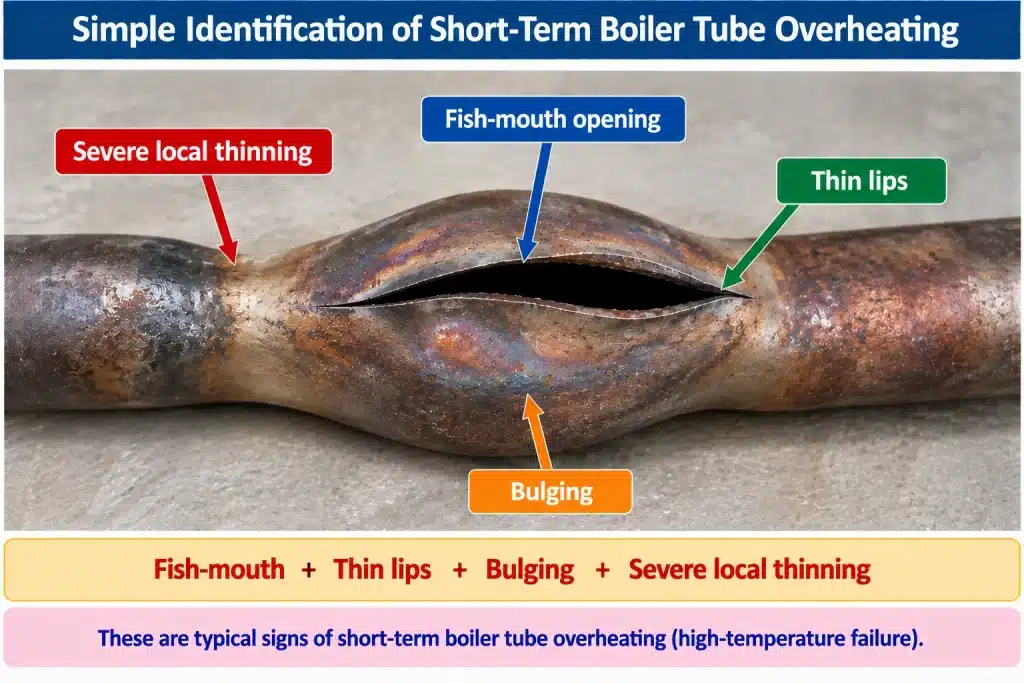
One of the most useful clues during failure investigation is the appearance of the broken tube. A typical short-term overheating failure may show:
- Fish-mouth opening
- Thin and sharp rupture lips
- Considerable wall thinning
- Bulging near the failed location
- Ductile-looking rupture
- Tapered or knife-edge contours
- Bending of the tube in some cases
The fish-mouth shape is particularly important. The rupture generally develops in the longitudinal direction because the tube wall is being overstressed by the internal pressure. High-velocity steam escaping through the opening can also produce bending or displacement of the tube near the failure.
Simple identification of Short-Term Boiler Tube Overheating
Fish-mouth + thin lips + bulging + severe local thinning
short-term/localized overheating should be considered during the investigation. It should not, however, be diagnosed from appearance alone. Metallography, thickness measurements and operating history are important for confirming the failure mechanism.
Causes of Short-Term Boiler Tube Overheating
1. Tube Blockage
Tube blockage is one of the important causes, particularly in superheater and reheater tubes. If a tube or tube circuit becomes partially or completely blocked, steam flow through that section is reduced. The tube continues receiving heat from the surrounding flue gas, but the steam is no longer removing sufficient heat.
As a result:
Reduced steam flow → increased tube metal temperature → reduced strength → deformation → rupture
Possible sources of blockage or restriction should therefore be investigated after a tube failure. This is particularly important when the failure is limited to one tube or a small group of tubes.
2. Poor Water or Steam Circulation
For waterwall tubes, adequate circulation is essential. If circulation is disturbed, the tube may not receive sufficient cooling. The furnace continues supplying heat to the tube surface. This condition can occur during abnormal boiler operation or a process upset. The result may be a rapid rise in tube metal temperature followed by local deformation and rupture. A waterwall tube failure associated with poor circulation can therefore be a flow problem first and a tube problem later.
3. Tube Leakage and Local Starvation
A leaking tube can create another problem. For example, a leakage or flow disturbance in a waterwall circuit can affect the circulation of the surrounding tubes. If the affected tube becomes starved of cooling flow, its temperature can increase rapidly. If the tube is also exposed to strong flame radiation or direct flame impingement, the heating rate becomes even higher. Therefore, after a waterwall tube failure, it is important to check:
- Nearby tube leakage
- Circulation conditions
- Flame pattern
- Burner operation
- Evidence of flame impingement
- Condition of adjacent tubes
4. Low Boiler Drum Water Level
In drum-type boilers, an abnormally low drum water level can reduce the effective cooling of waterwall tubes. If the affected area receives continued furnace heat without adequate cooling, tube metal temperature can rise rapidly. Therefore, the boiler operating history around the time of failure should be checked for:
- Drum level fluctuations
- Low-level alarms
- Feedwater disturbances
- Sudden load changes
- Abnormal circulation conditions
Low drum water level is one of the operating conditions associated with thin-lip overheating failures.
5. Rapid Startup and Improper Warm-Up
Rapid startup is another important operating factor. During startup, different boiler components do not heat at the same rate. Water, steam, tube metal and furnace surfaces are all undergoing temperature changes. If the prescribed startup and warm-up procedure is not followed, certain tubes can experience excessive temperature rise. The same problem can occur with:
- Improper warm-up
- Excessive heat input
- Excessive load changes
- Sudden changes in firing conditions
These operating conditions can produce short-term overheating and tube failure. For this reason, startup procedures are not simply for achieving synchronization quickly. They are also important for protecting boiler pressure parts.
6. Excessive Load Swing
A large and rapid load change can disturb the thermal and flow conditions inside the boiler. During such conditions, heat absorption, steam flow and furnace heat distribution can change rapidly. If a particular tube or tube circuit experiences insufficient cooling while heat input remains high, its metal temperature can rise beyond the safe operating range. Therefore, load changes should always be considered when investigating an unexplained short-term overheating failure.
7. Flame Impingement
Flame impingement can produce very high local heat input on a waterwall tube. Normally, the water inside the tube removes heat from the tube metal. But if circulation is already poor, the combination becomes dangerous:
Poor circulation + high local heat input = rapid tube temperature rise
The failure may therefore occur at a very localized position rather than across the entire boiler. During investigation, the burner condition and flame pattern near the failed tube should be checked.
Why Does the Tube Bulge Before It Bursts?
This is an important part of understanding the failure. When the tube becomes very hot, its mechanical strength decreases. The tube is still under internal pressure. The hot section therefore starts to deform outward.
As the tube expands:
Diameter increases → wall thickness decreases → stress increases further
This creates a progressive failure condition. Eventually, the remaining wall becomes too thin to contain the internal pressure and the tube opens. That is why the area immediately around a short-term overheating rupture often shows both bulging and wall thinning.
What Happens to the Tube Material During Rapid Overheating?
When a boiler tube overheats rapidly, the metal itself changes. These changes are important because they can provide evidence of how hot the tube became, how quickly it was heated, and how it subsequently cooled.
The changes mainly depend on:
- Tube material and grade
- Maximum temperature reached
- Rate of temperature increase
- Time for which the tube remained at high temperature
- Cooling rate after overheating
During rapid overheating, two important things happen: the strength of the steel decreases, and its internal microstructure can change.
What are Ac1 and Ac3?
Ac1 and Ac3 are important metallurgical temperatures used to understand structural changes in carbon and low-alloy steels during heating.
Ac1 is the temperature at which the steel starts forming austenite during heating.
Ac3 is the temperature above which the steel becomes fully austenitic during heating, for steels where Ac3 is applicable.
In simple terms:
Below Ac1 → Austenite formation has not started
Ac1 to Ac3 → Austenite formation is progressing
Above Ac3 → The steel becomes fully austenitic
For some carbon and low-alloy boiler steels, Ac1 is around 723°C, but this is not a fixed value for every boiler tube material. For example, the T91 tube had an Ac1 of about 800°C. Therefore, 723°C should not be considered the universal overheating or failure temperature for boiler tubes. The actual Ac1 and Ac3 temperatures depend on the chemical composition and grade of the steel.
What Happens Between Ac1 and Ac3?
When the tube is rapidly heated between Ac1 and Ac3, austenite formation takes place in the steel. If the tube is subsequently cooled rapidly, the final microstructure can be different from the original structure. Depending on the tube material and cooling conditions, structures such as bainite or other transformed structures may develop.
This is particularly useful in a failure investigation because the microstructure near the failed portion may be different from the unaffected portion of the same tube. For example, in a waterwall tube failure, examination of the failed area showed evidence of high-temperature exposure followed by rapid cooling associated with steam leakage. Such metallurgical evidence can support the conclusion that the tube experienced a rapid temperature excursion and subsequent quenching.
Why is This Important in Boiler Tube Failure Investigation?
The failed tube does not only tell us where the rupture occurred. Its shape, wall thickness and microstructure can provide clues about the failure process.
Engineers may compare:
Unaffected tube → Heated/affected area → Rupture area
and examine:
- Wall-thickness reduction
- Bulging
- Grain structure
- Phase transformation
- Hardness
- Metallographic features
This helps determine whether the tube experienced rapid overheating, localized overheating, steam/water starvation, or another failure mechanism.
Important: Ac1 and Ac3 are metallurgical transformation temperatures. They are not the allowable operating temperature of the tube and they are not necessarily the exact temperature at which the tube will burst. A tube can lose sufficient strength to deform or rupture even below Ac1, depending on the material, stress and operating conditions.
How to Investigate a Short-Term boiler Tube Overheating Failure
When a boiler tube fails, simply replacing the tube is not enough. The failed tube should be examined together with the operating history.
1. Check the rupture appearance
Look for: Fish-mouth opening, Thin lips, Bulging, Wall thinning, Bending, Direction of rupture.
2. Measure tube thickness
Take thickness measurements: At the failure, Around the failure, Away from the failure, On both sides of the tube. This helps determine whether the thinning is localized.
3. Check the tube material
Confirm: Material grade, Chemical composition, Tube dimensions, Heat treatment condition, where relevant.
4. Perform metallographic examination
Compare the microstructure:
Failure location ↔ nearby location ↔ unaffected tube
This can show whether the tube experienced a significant thermal excursion.
5. Check boiler operating data
Review: Boiler load, Drum level, Feedwater flow, Steam flow, Startup history, Load changes, Furnace conditions, Burner operation, Any abnormal alarms.
6. Inspect the complete flow circuit
For SH/RH tubes, check for possible flow restriction or blockage, For waterwalls, check circulation and any condition that could have caused local starvation.
The objective should be to find why the tube became overheated, rather than simply identifying that it was overheated.
How to Prevent Short-Term Boiler Tube Overheating?
Prevention of short-term boiler tube overheating mainly depends on maintaining adequate water or steam flow and preventing a rapid rise in tube-metal temperature. Good startup practices, proper operation and timely investigation of abnormal conditions are therefore important.
1. Follow the Correct Startup Procedure
Boiler startup should always be carried out according to the approved boiler/OEM procedure.
- Avoid unnecessarily rapid firing or heating.
- Establish the required water or steam flow before applying high heat input.
- Follow the prescribed warm-up sequence.
- Do not increase firing faster than the boiler design and operating procedure permits.
This is particularly important for superheater and reheater circuits, where inadequate steam flow during startup can result in rapid tube-metal temperature rise.
2. Ensure Proper Condensate Removal
During shutdown and startup, condensate can remain in superheater or reheater circuits and restrict steam flow. Therefore:
- Ensure proper draining of circuits as required by the boiler design.
- Follow the prescribed procedure for clearing or boiling out condensate.
- Pay particular attention to conditions that can restrict steam flow during startup.
3. Maintain Adequate Water and Steam Flow
The tube must have sufficient cooling to remove the heat received from the furnace or hot flue gas. During operation, ensure:
- Adequate water circulation in waterwall circuits.
- Required steam flow through SH/RH circuits.
- Proper drum water level.
- No abnormal restriction in the flow path.
A reduction in cooling flow combined with high heat input can cause the tube-metal temperature to rise rapidly.
4. Check for Tube Blockage
Tube blockage can severely restrict water or steam flow and is an important condition to investigate after a short-term overheating failure. If a failure occurs, inspect the affected circuit and, where appropriate, nearby or similar tubes and bends for:
- Foreign material
- Deposits or scale
- Oxide-related blockage
- Other flow restrictions
The objective is not only to replace the failed tube but also to determine why the cooling flow was lost.
5. Control Firing and Load Changes
Avoid operating conditions that can produce a sudden increase in tube-metal temperature. During load changes:
- Avoid unnecessary rapid load swings.
- Control firing according to the boiler operating procedure.
- Monitor thermal conditions during major load changes.
- Pay attention to abnormal SH/RH temperature behavior.
Heat input should remain compatible with the available cooling flow.
6. Monitor Temperature and Operating Parameters
Early identification of abnormal conditions can help prevent tube damage. Where measurements are available, monitor:
- SH outlet temperature
- RH outlet temperature
- Tube-metal temperature
- Temperature differences between relevant locations
- Steam flow
- Drum water level
- Startup and load-change trends
A sudden or abnormal temperature rise may indicate a flow restriction, inadequate cooling, excessive heat input or another operating problem.
7. Investigate the Root Cause After a Tube Failure
After a tube failure, do not simply replace the damaged tube and return the boiler to service without understanding the failure mechanism. The investigation should consider:
Tube condition → Flow condition → Heat input → Operating history → Failure location → Metallurgical evidence → Root cause
If the original flow, heat-transfer or operating problem remains, another tube can fail again.
Practical Takeaway
The basic principle is simple:
Adequate cooling + controlled heat input + proper startup + stable operation = lower risk of short-term overheating.
When a tube fails, the failure shape, wall thinning, bulging and metallurgical condition should be examined together with the boiler’s operating history. This helps identify the actual cause rather than treating the failed tube as the cause itself.
Conclusion
Short-term boiler tube overheating is mainly associated with a rapid rise in tube-metal temperature combined with inadequate water or steam cooling. Conditions such as tube blockage, poor circulation, low drum level, rapid startup, excessive load changes and excessive heat input can contribute to this failure.
The typical bulging, severe wall thinning and thin-lip or fish-mouth rupture provide important clues during failure investigation. Metallurgical examination can provide additional evidence about the temperature excursion and heating/cooling history.
Therefore, preventing short-term overheating requires more than simply controlling temperature. Proper startup, adequate flow, controlled heat input, stable operation and systematic investigation of abnormal conditions are all important.
When a tube fails, identifying and correcting the root cause is essential. Replacing only the failed tube without correcting the underlying operating or flow problem may result in repeated tube failures.
Related Boiler Tube Failure Articles:
Boiler Tube Failure: Why Do Tubes Fail Even When Pressure and Temperature Are Normal?
Long-Term Boiler Tube Overheating: Causes, Creep Mechanism & Prevention
Why Does Hydrogen Damage Cause Boiler Tube Failure?