
The chemistry department in a thermal power plant plays an important role in maintaining water quality, fuel quality, equipment reliability, combustion performance and environmental compliance. Its work extends far beyond laboratory testing. From producing demineralized (DM) water and controlling steam-water chemistry to analyzing coal, transformer oil and lube oil, the chemistry department supports many of the plant’s critical systems.
In a modern thermal power plant, proper chemical control helps prevent corrosion, scaling, deposits, fouling and equipment deterioration, while also supporting efficient and reliable plant operation.
What Does the Chemistry Department Do in a Thermal Power Plant?
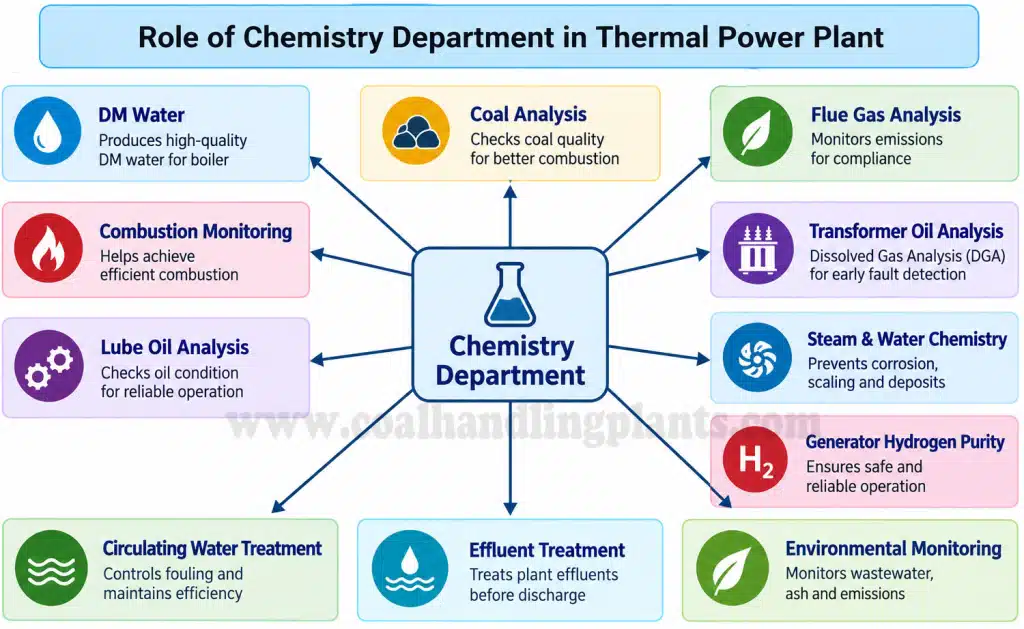
The role of the chemistry department in a thermal power plant can be broadly divided into the following activities:
-
DM water production and cycle-water management
-
Clarified water production
-
Coal and oil analysis
-
Flue gas analysis
-
Combustion monitoring
-
Transformer oil analysis
-
Lube oil and wear-debris analysis
-
Steam and water chemistry control
-
Generator hydrogen purity monitoring
-
Circulating water treatment
-
Environmental monitoring
-
Plant effluent treatment
-
Chemical activities during plant commissioning
Let’s understand these chemistry activities in a thermal power plant in detail.
1. DM Water Production for Boiler Cycle Water
Demineralized (DM) water is an important requirement for the boiler and steam-water cycle.
Water acts as the working medium in the boiler cycle. Although the cycle operates largely as a closed loop, some water is lost during plant operation and maintenance activities. Therefore, make-up water is required to maintain the cycle inventory.
For a typical 1000 MW subcritical thermal power plant, the average make-up water requirement can be around 2100 MT/day, depending on the plant arrangement and operating conditions.
DM water may also be used for certain equipment cooling applications, including bearing oil coolers associated with:
- ID fans
- FD fans
- PA fans
- Other major rotating equipment
Maintaining good make-up-water quality is important because dissolved minerals and impurities can concentrate in the boiler cycle and contribute to corrosion and deposit formation.
2. Production of Clarified Water
Raw water entering a thermal power plant contains suspended solids and other impurities. Before it is used for different plant applications or processed further to produce DM water, it may undergo treatment processes such as:
- Filtration
- Flocculation
- Clarification
The resulting clarified water can be used for several plant requirements and may also serve as feedwater for the DM water production system. Depending on the plant arrangement, clarified water can be used for:
- Air-conditioning systems
- Compressor coolers
- Equipment cooling
- Drinking-water treatment
Therefore, water treatment chemistry begins with understanding and controlling the quality of the raw water entering the plant.
3. Coal and Oil Analysis
Fuel quality has a major influence on thermal power plant operation and performance. The chemistry department can analyze coal to determine important properties such as:
- Calorific value
- Ash content
- Moisture content
- Fuel composition
The calorific value indicates the amount of heat that can be obtained from the fuel. Changes in coal quality can affect boiler operating conditions, combustion performance and overall plant performance. Oil analysis is also important where liquid fuels or different oil systems are used in the plant.
4. Flue Gas Analysis
Coal combustion produces flue gas containing different gaseous and particulate components. The chemistry department may analyze flue gas parameters such as:
- Oxygen (O₂)
- Carbon monoxide (CO)
- Sulfur-related compounds
- Particulate matter
- Other regulated pollutants
Flue gas monitoring helps the plant assess combustion performance and determine whether emissions are within applicable environmental requirements.
5. Chemistry in Combustion Monitoring
Good combustion is essential for efficient boiler operation. The chemistry department in a thermal power plant can support combustion monitoring through analysis of parameters such as coal fineness, flue-gas oxygen, carbon monoxide and unburnt carbon.
Mill Fineness
The fineness of pulverized coal leaving the mills affects combustion performance. Poor coal fineness can contribute to incomplete combustion and reduced boiler performance.
Flue Gas Oxygen
Flue-gas oxygen provides an indication of the excess air supplied to the furnace.
Carbon Monoxide
CO levels can provide an indication of incomplete combustion or combustion conditions requiring investigation.
Unburnt Carbon
Unburnt carbon in ash indicates that some combustible material has not been completely burned.
Monitoring these parameters helps engineers evaluate and optimize the coal-air ratio and combustion process.
6. Transformer Oil Analysis
The chemistry department also supports the condition monitoring of oil-filled power transformers. When insulation or internal components of a transformer deteriorate, different gases can be produced under different fault conditions. These gases can dissolve in the transformer oil. Dissolved Gas Analysis (DGA) examines gases present in transformer oil and can provide information about developing internal problems.
DGA supports:
- Transformer condition monitoring
- Early fault detection
- Maintenance planning
- Transformer reliability
Therefore, transformer oil DGA is an important chemistry activity in a thermal power plant.
7. Lube Oil Testing and Wear-Debris Analysis
Lubricating oil is essential for reliable operation of rotating equipment. In a thermal power plant, lube oil helps:
- Lubricate bearings
- Remove heat
- Maintain an appropriate oil film
- Protect components from excessive wear
However, lube oil can deteriorate because of contamination and degradation. Common contaminants include:
- Moisture
- Mechanical particles
- Wear debris
- Sludge
- Other contaminants
Regular lube oil analysis helps determine the condition of the oil and identify abnormal wear. Wear-debris analysis can also provide useful information about the condition of bearings and other rotating equipment.
8. Steam and Water Chemistry Control
Steam-water chemistry is one of the most important areas of thermal power plant chemistry. Water circulating through the boiler and steam cycle can contain dissolved or suspended impurities. If chemistry is not properly controlled, deposits and corrosion products can accumulate on boiler and turbine components.
Potential problems include:
- Boiler tube deposits
- Corrosion
- Scale formation
- Turbine blade deposits
- Reduced heat transfer
- Reduced turbine efficiency
Therefore, steam and water chemistry parameters are monitored and maintained according to the plant’s chemistry program and equipment requirements. Good chemistry control helps protect both the boiler and turbine.
9. Generator Hydrogen Purity Monitoring
Large turbo-generators commonly use hydrogen gas for rotor cooling. Hydrogen provides effective cooling because of its favorable physical properties. However, maintaining appropriate hydrogen purity is important for generator safety and performance. If hydrogen mixes with air within a combustible concentration range, a fire or explosion hazard can exist.
Therefore, generator hydrogen purity is monitored to help maintain:
- Generator cooling performance
- Operational safety
- Hydrogen-system reliability
This makes gas analysis another important responsibility of the power plant chemistry department.
10. Circulating Water Treatment for the Condenser
The condenser uses circulating cooling water to remove heat from exhaust steam leaving the steam turbine. Condenser performance directly affects turbine operating conditions and overall plant efficiency.
Cooling-water systems can experience biological growth such as:
- Algae
- Microorganisms
- Other biological deposits
These deposits can foul condenser tubes and reduce heat-transfer performance. Chemical treatment of circulating water helps control biological growth and maintain condenser cleanliness.
Proper condenser cooling-water treatment therefore supports condenser performance and heat-transfer efficiency.
11. Environmental Pollution Monitoring
Environmental monitoring is another major responsibility of the chemistry department. Apart from flue-gas monitoring, environmental programs may include analysis of:
- Ash pond discharge
- Cooling-water discharge
- Turbidity
- Chemical constituents in wastewater
- Temperature of discharged cooling water
- Other applicable environmental parameters
Regular analysis helps determine whether plant discharges comply with applicable environmental requirements.
12. Treatment of Plant Effluent
A thermal power plant produces different liquid and solid waste streams during operation. These can originate from:
- Water-treatment systems
- Boiler and equipment cleaning
- Cooling-water systems
- Ash-handling systems
- Other plant processes
Effluent-treatment systems are used to treat these streams before reuse or discharge. Depending on the plant design, the treatment objective may include zero-liquid-discharge operation or treatment to meet applicable discharge limits. Chemistry is essential for selecting, monitoring and controlling the appropriate treatment processes.
13. Chemistry During Plant Commissioning
The role of chemistry does not begin only after the plant starts commercial operation. Chemistry activities are also important during thermal power plant commissioning. Before equipment is placed into normal operation, various systems may require cleaning and preparation.
Boiler Chemical Cleaning
Boiler water-side surfaces may require chemical cleaning to remove contaminants and deposits introduced during manufacturing, construction and installation.
Turbine Lube Oil Flushing
Lube-oil systems are flushed to remove foreign particles and contaminants before the system is placed into service.
Feedwater System Cleaning
Cleaning activities may be performed to remove construction debris and contaminants from relevant systems. These activities help ensure that equipment enters service in an acceptable condition.
Practical Work of a Chemist in a Thermal Power Plant
The work of a power plant chemist is closely connected with day-to-day plant operation. A chemistry team may collect samples, perform laboratory analysis, monitor trends, compare results with specified limits and communicate abnormal conditions to the concerned plant departments.
For example:
Sample Collection → Laboratory Analysis → Compare Results → Identify Abnormality → Inform Operation/Maintenance → Corrective Action → Follow-up Analysis
This makes the chemistry department an important part of condition monitoring, troubleshooting and preventive maintenance.
Why Is the Chemistry Department Important?
The importance of the chemistry department can be understood by looking at its effect on different plant systems.
Boiler Protection
Proper water chemistry helps reduce corrosion and deposit formation.
Turbine Protection
Controlled steam-water chemistry helps minimize deposits and corrosion on turbine components.
Equipment Reliability
Lube-oil and transformer-oil analysis can help identify developing equipment problems.
Plant Efficiency
Fuel analysis, combustion monitoring and condenser-water treatment can contribute to maintaining efficient plant operation.
Environmental Compliance
Flue-gas, wastewater and cooling-water analysis helps monitor environmental performance.
Safe Operation
Hydrogen-purity monitoring and proper chemical handling contribute to safe plant operation.
Chemistry and Thermal Power Plant Efficiency
Chemistry can have both a direct and indirect influence on thermal power plant efficiency. For example, deposits on boiler heat-transfer surfaces can reduce heat transfer. Condenser fouling can also reduce condenser performance and affect turbine operating conditions. Poor fuel quality or improper combustion can increase losses as well.
Therefore, chemical monitoring can help engineers investigate problems such as:
- Increasing heat rate
- Reduced boiler efficiency
- Poor combustion
- Condenser performance deterioration
- Increased fuel consumption
- Equipment degradation
In this way, chemistry becomes an important tool for performance monitoring and troubleshooting.