
Thermal power plants generate large quantities of bottom ash as a by-product of coal combustion. Efficient and continuous removal of this ash is critical to maintain boiler performance, reduce clinker formation and ensure safe operation. One of the most reliable technologies for this purpose is the Submerged Scraper Chain Conveyor Systems (SSCC).
The SSCC is installed directly beneath the furnace bottom ash hopper, where it cools, dewaters and transports ash in a controlled and dust-free manner. Its rugged design makes it suitable for high-temperature, abrasive and moist materials, which are difficult to handle with pneumatic or belt systems.
What is a Submerged Scraper Chain Conveyor?
A Submerged Scraper Chain Conveyor is a mechanical system used in ash handling plants. It consists of a water-filled trough housing a forged chain assembly fitted with scrapers. As the chain moves, the scrapers drag quenched ash from the hopper through the trough, lift it along an inclined section, and discharge it for storage or disposal.
It performs three main tasks simultaneously:
- Cooling hot ash in water.
- Sealing the furnace bottom.
- Transporting ash to crushers, silos, or slurry systems.
Construction and Components of Submerged Scraper Chain Conveyor Systems
A typical SSCC used in an ash handling plant consists of the following major components:
Image Source: https://www.babcock.com/

- Bottom Ash Hopper – Collects hot ash directly from the furnace; lined with refractory and fitted with a water seal.
- Water-Filled Trough (Casing) – Encloses the conveyor chain; cools and quenches ash.
- Forged Chain Assembly – Heavy-duty forged steel links that provide traction.
- Scraper Bars (Flights) – Attached to the chain; drag ash along the trough.
- Drive Unit – Motor, fluid coupling, gearbox, and drive sprocket; supplies power and overload protection.
- Sprockets – Head sprocket drives the chain; tail sprocket guides it.
- Chain Tensioning Device – Maintains proper chain tightness.
- Return Chain Path – Lower loop of the chain returning beneath the trough.
- Discharge Chute – Outlet for cooled ash to crushers, silos, or trucks.
- Support Frame – Structural base for the conveyor assembly.
Working Principle of Submerged Scraper Chain Conveyor System
The working of a Submerged Scraper Chain Conveyor can be explained step by step:
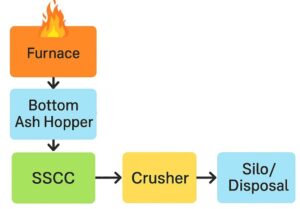
- Ash Collection – Bottom ash drops from the boiler furnace into the water-filled hopper.
- Cooling and Quenching – Water reduces the temperature of the ash and prevents clinker formation.
- Dragging Action – Scraper bars attached to the moving chain drag ash through the trough.
- Inclined Conveying – Ash is lifted along an inclined section by the chain.
- Dewatering – Excess water drains back into the trough.
- Discharge – Cooled ash is dropped through the discharge chute into crushers, silos, or trucks.
- Return Path – The chain loops back along the lower path to complete the cycle.
Types of Submerged Scraper Chain Conveyors
Ash handling plant use different designs of Submerged Scraper Chain Conveyors (SSCCs) based on ash load and layout. Single-chain conveyors handle ash in small boilers with lower generation, while double-chain conveyors provide higher strength for large thermal units. Engineers prefer the inclined SSCC in modern plants because it lifts ash out of the water trough for dewatering and discharge. Retrofit or space-limited stations install horizontal designs that run flat. Small captive power plants choose compact modular SSCCs, and heavy-duty systems with integrated crushers break large ash clinkers before storage or disposal
Advantages of SSCC in Ash Handling Plant
- Continuous Operation – Ensures 24×7 removal of ash from boiler hoppers.
- Safe Cooling – Water quenching minimizes thermal stress and clinker formation.
- Dust-Free Handling – Enclosed trough prevents ash dust pollution.
- Robust Design – Handles abrasive, heavy, and moist ash with ease.
- Energy Efficiency – Consumes less power than pneumatic ash handling for bottom ash.
- Low Maintenance – Simple mechanical system compared to hydraulic slurry systems.
Limitations of SSCC in Ash Handling Plant
- Higher Initial Cost than basic mechanical conveyors.
- Regular Maintenance Required for chain, sprockets, and liners.
- Space Requirement under boiler hoppers.
Applications in Thermal Power Plants
- Bottom Ash Removal directly from furnace hoppers.
- Ash Dewatering and Crushing before storage or transport.
- Intermediate Transfer between hoppers, crushers, and silos.
- Integration with Disposal Systems like slurry pipelines or dry ash silos.
Maintenance Practices
For reliable operation, SSCC requires routine inspection and servicing:
- Check chain wear and elongation.
- Inspect and lubricate sprockets and bearings.
- Monitor chain tension using the tensioning device.
- Replace worn liners, scrapers, and chains.
- Ensure motor load and vibration remain within limits.
- Keep water level in the trough at recommended depth.
Safety Measures
- Install guards on moving sprockets and chain drives.
- Provide emergency stop pull-cords along the conveyor.
- Seal housings to prevent dust leakage.
- Use LOTO (Lock-out/Tag-out) during maintenance.
Problems and Corrective Actions in Submerged Scraper Chain Conveyor
1. Problem: Chain Elongation or Breakage
- Cause: Continuous wear of chain links, poor lubrication, misalignment of sprockets, or overload due to clinker lumps.
- Corrective Action:
- Monitor chain elongation regularly.
- Lubricate as per schedule.
- Replace worn or broken chain links immediately.
- Avoid clinker formation by maintaining proper furnace operation.
2. Problem: Scraper Bar (Flight) Wear or Breakage
- Cause: Abrasive ash, improper material of construction, or excessive impact load from large lumps.
- Corrective Action:
- Use wear-resistant alloy or cast iron scrapers.
- Inspect weekly and replace damaged scrapers.
- Ensure uniform ash discharge from furnace to avoid impact loading.
3. Problem: Excessive Ash Leakage / Dust Escape
- Cause: Worn liners or trough sealing plates, improper water level in trough.
- Corrective Action:
- Replace liners and sealing plates.
- Maintain water level as per OEM guidelines.
- Check for cracks in the trough and repair immediately.
4. Problem: Chain Jamming / Stoppage
- Cause: Foreign material entry, clinker build-up, misalignment of chain.
- Corrective Action:
- Stop conveyor immediately to prevent motor burnout.
- Remove obstruction manually after ensuring LOTO (Lock-out/Tag-out).
- Clean trough and prevent clinker entry by maintaining water seal depth.
5. Problem: High Motor Power Consumption
- Cause: Overloaded trough, chain friction due to lack of lubrication, worn sprockets.
- Corrective Action:
- Check ash load and regulate furnace discharge.
- Lubricate chain and bearings regularly.
- Replace sprockets if tooth wear is excessive.
6. Problem: Water Carryover with Ash Discharge
- Cause: Improper dewatering arrangement or high water level in trough.
- Corrective Action:
- Adjust water level and maintain at recommended height.
- Ensure proper drainage system in discharge section.
7. Problem: Frequent Tripping of Drive Motor
- Cause: Overload due to ash lump, jammed chain, or high starting torque.
- Corrective Action:
- Check for obstructions before restart.
- Inspect clutch/ fluid coupling for proper function.
- Use soft starter or VFD if recommended.
8. Problem: Abnormal Vibration or Noise
- Cause: Misalignment of sprockets, loose chain, damaged bearings.
- Corrective Action:
- Realign sprockets.
- Tighten chain using tensioning device.
- Replace defective bearings.
Frequently Asked Questions (FAQs) of Submerged Scraper Chain Conveyor Systems
Because it consumes less water, generates less slurry, and provides mechanical reliability with lower maintenance costs.
Yes. The water trough quenches ash at temperatures up to 1000°C safely.
Generally below 1 m/s to ensure controlled movement and reduced wear.
The ash remains submerged in water and enclosed in the trough, minimizing dust emission.
With proper lubrication and inspection, forged chains last several years before replacement.
It is discharged into crushers, silos, or truck loading systems for further handling.
They are typically made from wear-resistant alloy steel or cast iron.
By a tail sprocket equipped with a hydraulic or spring-loaded tensioning device.
No. Fly ash is better handled by pneumatic systems. SSCC is meant for bottom ash.
Water quenches hot ash, prevents clinker formation, seals the furnace, and reduces dust.