Coal-fired thermal power plants have continuously evolved to achieve higher efficiency and lower fuel consumption. One of the most important developments has been the improvement of boiler steam conditions.
By increasing steam pressure and temperature, the average temperature at which heat is added to the Rankine cycle can be increased. This can improve cycle efficiency and reduce the amount of coal required for a given electrical output.
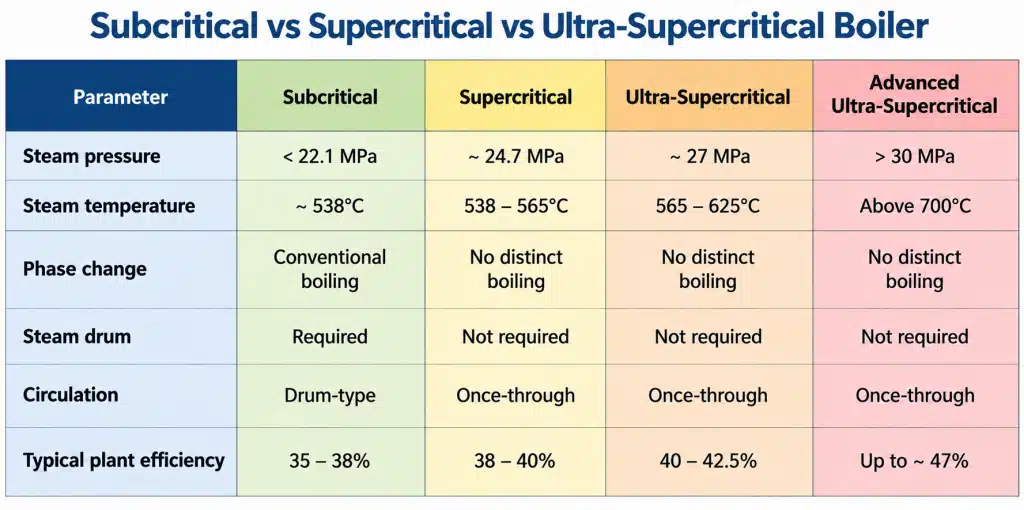
Based on steam pressure and temperature, pulverized-coal boilers are commonly discussed in four categories:
- Subcritical boiler
- Supercritical (SC) boiler
- Ultra-supercritical (USC) boiler
- Advanced ultra-supercritical (A-USC) boiler
The most important difference between these boiler technologies is the behavior of water during heating, the requirement for a steam drum, the circulation arrangement, and the achievable steam conditions.
What Is the Critical Point of Water?
At atmospheric pressure, water boils at 100°C. During boiling, the supplied heat does not immediately increase the temperature. Instead, the heat is used to convert liquid water into steam.
This energy is called the latent heat of vaporization. At atmospheric pressure, the latent heat of vaporization of water is approximately 2256 kJ/kg.
When pressure increases, the boiling point of water also increases, while the latent heat of vaporization decreases.
Eventually, water reaches a condition known as the critical point.
The critical point of water is approximately:
- Critical pressure: 220.6 bar (22.06 MPa)
- Critical temperature: 374.15°C
- Latent heat of vaporization: Zero
At this point, there is no distinct boundary between liquid water and steam. Therefore, there is no conventional boiling process.
This critical point is the basis for distinguishing subcritical and supercritical boilers.
What Is a Subcritical Boiler?
A subcritical boiler operates at a pressure below the critical pressure of water, approximately 220.6 bar.
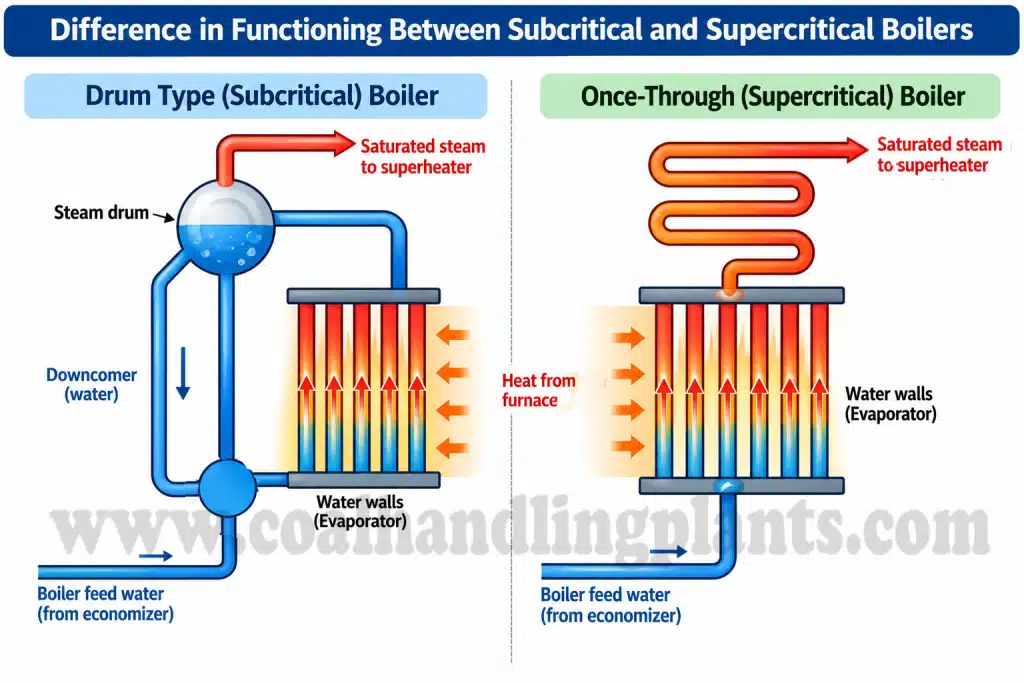
In a subcritical boiler, water undergoes a conventional phase change from liquid to steam. Therefore, water and steam exist as separate phases during evaporation.
Because a mixture of water and steam is produced in the evaporator, a steam drum is used to separate steam from water.
Working of a Subcritical Boiler
The basic process is:
Feedwater → Economizer → Water Walls/Evaporator → Steam Drum → Superheater → Turbine
Inside the furnace water walls, water absorbs heat and partially converts into steam.
The water-steam mixture enters the steam drum, where steam is separated from water.
The separated steam then passes through the superheater before entering the turbine.
Typical Characteristics of a Subcritical Boiler
Conventional subcritical coal-fired power plants may operate around:
- Steam pressure: Less than 22.1 MPa
- Steam temperature: Approximately 538°C
- Plant efficiency: Approximately 35–38%
The exact values vary with plant design.
What Is a Supercritical Boiler?
A supercritical boiler operates above the critical pressure of water.
Above approximately 220.6 bar, there is no distinct liquid-to-steam phase transition. Instead, water continuously changes into a supercritical fluid as temperature and pressure increase.
Because there is no conventional boiling process, a steam drum is not required for steam-water separation.
Most supercritical boilers therefore use a once-through arrangement.
Working of a Supercritical Boiler
The general flow is:
Feedwater → Economizer → Furnace Water Walls → Superheater → Turbine
Water passes through the boiler circuitry only once and is progressively heated until it becomes supercritical fluid and then steam suitable for turbine operation.
Typical Characteristics of a Supercritical Boiler
Conventional supercritical coal-fired power plants may operate around:
- Steam pressure: Approximately 24.7 MPa
- Steam temperature: Approximately 538–565°C
- Plant efficiency: Approximately 38–40%
The exact values vary with plant design and operating conditions.
What Is an Ultra-Supercritical Boiler?
An ultra-supercritical (USC) boiler operates at even higher pressure and temperature than a conventional supercritical boiler.
The objective is to increase the efficiency of the Rankine cycle by raising the steam conditions.
Ultra-supercritical coal-fired power plants may operate around:
- Steam pressure: Approximately 27 MPa
- Steam temperature: 565–625°C
- Plant efficiency: Approximately 40–42.5%
USC boilers use a once-through arrangement and do not require a conventional steam drum.
Because of the extremely high temperature and pressure, advanced materials capable of maintaining their mechanical properties at elevated temperatures are required.
What Is an Advanced Ultra-Supercritical Boiler?
Advanced ultra-supercritical (A-USC) technology is a further development aimed at achieving even higher steam temperatures and power plant efficiency.
Advance Ultra-supercritical coal-fired power plants may operate around:
- Steam pressure: Above 30 MPa
- Turbine inlet steam temperature: 700–760°C
- Final superheater/reheater metal temperature: Up to approximately 815°C
- Plant efficiency: Up to approximately 47%
These temperatures are considerably higher than those used in conventional subcritical plants.
Why Does Increasing Steam Temperature Improve Efficiency?
The boiler supplies heat to the working fluid, and the steam then expands through the turbine to produce useful work.
Increasing steam temperature and pressure can increase the average temperature of heat addition to the Rankine cycle.
This improves the thermodynamic efficiency of the cycle.
As a result, boiler technology has progressively moved toward:
Subcritical → Supercritical → Ultra-supercritical → Advanced ultra-supercritical
Higher efficiency can reduce the amount of coal required per unit of electricity generated.