
Coal-fired thermal power plants traditionally burn pulverized coal in a boiler to produce steam for a steam turbine. Integrated Gasification Combined Cycle (IGCC) takes a different approach: instead of directly burning coal in the boiler, the coal is first converted into a combustible gas called syngas.
The syngas is cleaned and then used as fuel in a gas turbine to generate electricity. The hot exhaust gases from the gas turbine are recovered in a Heat Recovery Steam Generator (HRSG) to produce steam, which drives a steam turbine and generates additional electricity.
This integration of coal gasification, gas-turbine power generation and steam-turbine power generation is the basic principle of an IGCC power plant.
IGCC makes use of the fuel energy in two power-generation stages – gas turbine + steam turbine – which can provide a higher overall efficiency than a conventional coal fired steam cycle plant, depending on the plant design and operating conditions.
What Is Integrated Gasification Combined Cycle (IGCC)?
Integrated Gasification Combined Cycle (IGCC) is a thermal power-generation technology that converts coal or another carbon-based feedstock into synthesis gas (syngas) before electricity is generated.
In a coal-based IGCC plant, pulverized coal is gasified under controlled pressure and temperature using oxygen and/or steam. The resulting syngas mainly contains hydrogen (H₂) and carbon monoxide (CO), along with other gases and impurities.
The raw syngas is then cleaned before being supplied to a gas turbine. The gas turbine produces electricity, while its hot exhaust gases are used to generate steam in an Heat Recovery Steam Generator (HRSG). The steam subsequently drives a steam turbine to produce additional electricity.
How Does an IGCC Power Plant Work?
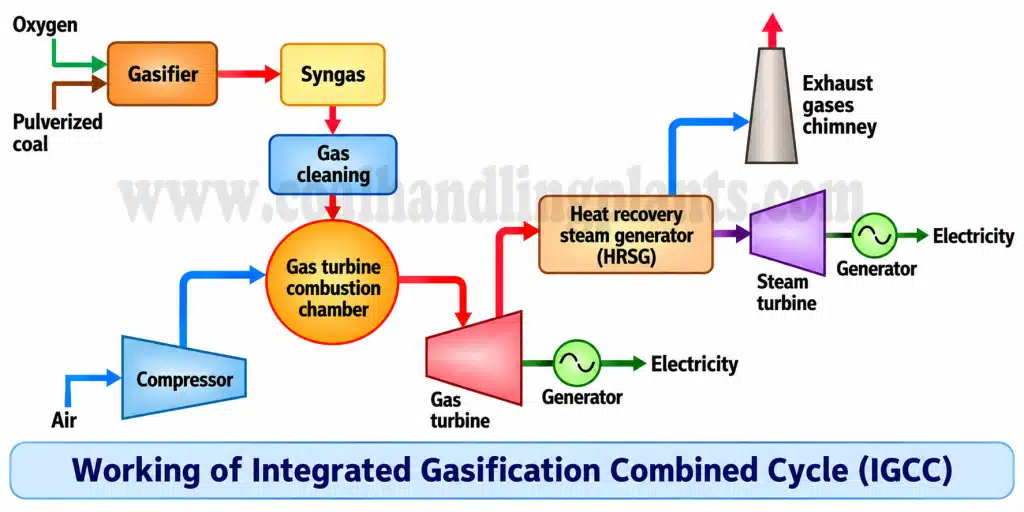
The basic IGCC process can be understood through the following sequence:
Pulverized Coal → Gasifier → Syngas → Syngas Cleaning → Gas Turbine → HRSG → Steam Turbine → Electricity
Each stage performs an important function in converting the energy contained in coal into electrical power.
1. Coal Preparation
The process begins with pulverized coal.
The coal is prepared and supplied to the gasifier, where it is subjected to controlled pressure and temperature conditions.
Unlike a conventional coal-fired boiler, the primary objective at this stage is not to directly produce steam. Instead, the coal is converted into syngas.
2. Coal Gasification
Gasification is the key process in an IGCC plant.
Pulverized coal reacts with oxygen and/or steam inside the gasifier.
Under controlled operating conditions, the coal is converted into synthesis gas, commonly called syngas.
The main components of syngas are:
-
Hydrogen
-
Carbon monoxide
The gas also contains impurities that must be removed before it is burned in the gas turbine.
Simplified Process
Pulverized Coal + Oxygen/Steam → Gasifier → Syngas
Gasification therefore converts solid coal into a gaseous fuel that can be used by a gas turbine.
3. Syngas Cleaning
The raw syngas produced by the gasifier contains unwanted substances and impurities.
Therefore, it is subjected to a gas-cleaning process before being supplied to the gas turbine.
One important objective is to remove impurities such as sulfur.
After cleaning, the syngas becomes suitable for combustion in the gas turbine.
The simplified sequence is:
Raw Syngas → Cleaning → Cleaned Syngas
4. Gas Turbine Power Generation
The cleaned syngas is supplied to the combustion gas turbine.
The syngas is burned, producing hot gases that expand through the gas turbine.
The gas turbine drives an electrical generator and produces electricity.
Therefore:
Cleaned Syngas → Combustion → Gas Turbine → Generator → Electricity
However, the process does not end with the gas turbine.
A significant amount of heat remains in the hot turbine exhaust gases.
This heat is recovered and used to generate additional power.
5. Heat Recovery Steam Generator (HRSG)
The exhaust gases leaving the gas turbine are still at a high temperature.
Instead of releasing this heat directly to the atmosphere, the hot exhaust gases are passed through a Heat Recovery Steam Generator (HRSG).
The HRSG recovers heat from the gas-turbine exhaust and uses it to produce steam.
The simplified process is:
Gas Turbine Exhaust → HRSG → Steam
This steam is then supplied to the steam turbine.
6. Steam Turbine Power Generation
The steam produced in the HRSG is expanded through a steam turbine.
The steam turbine drives another generator, producing additional electricity.
Therefore:
HRSG → Steam → Steam Turbine → Generator → Electricity
The IGCC plant consequently produces power from both the gas turbine and the steam turbine.
Why Is It Called a Combined Cycle?
The term combined cycle comes from the combination of two power-generation cycles in one plant.
Gas-Turbine Cycle
Syngas is burned in the gas turbine to produce electricity.
Steam-Turbine Cycle
The hot exhaust from the gas turbine is recovered in the HRSG to produce steam, which then produces additional electricity through the steam turbine.
Therefore:
Gas Turbine + Steam Turbine = Combined Cycle
This arrangement allows the plant to make additional use of the heat contained in the gas-turbine exhaust.
Advantages of IGCC Power Plant Technology
1. Higher Potential Efficiency
IGCC combines gas-turbine and steam-turbine generation, allowing energy to be extracted through two stages.
2. Utilization of Coal as a Gasified Fuel
Instead of directly burning pulverized coal in a conventional boiler, the coal is first converted into syngas.
3. Syngas Cleaning
The syngas can be cleaned before combustion, including removal of impurities such as sulfur.
4. Exhaust Heat Recovery
The gas-turbine exhaust contains significant heat that can be recovered through an HRSG to produce steam.
5. Combined Power Generation
Electricity is generated through both the gas turbine and the steam turbine.
Limitations and Challenges of Integrated Gasification Combined Cycle
IGCC technology also involves complex equipment and processes.
The plant requires:
-
A gasification system
-
Syngas cleaning equipment
-
Gas-turbine systems
-
HRSG
-
Steam-turbine systems
-
Integration of several process systems
The integration of these systems makes IGCC considerably more complex than a conventional pulverized-coal boiler arrangement.
Therefore, plant design, operation and maintenance require careful coordination between the gasification and power-generation systems.
IGCC vs Conventional Coal-Fired Thermal Power Plant
| Feature | Conventional Coal-Fired Plant | IGCC Plant |
|---|---|---|
| Primary fuel processing | Coal is directly combusted | Coal is gasified |
| Main fuel to turbine/boiler | Pulverized coal | Syngas |
| Main combustion equipment | Boiler | Gas turbine combustor |
| Steam generation | Boiler | HRSG using gas-turbine exhaust |
| Gas turbine | Not normally the primary generation unit | Yes |
| Steam turbine | Yes | Yes |
| Heat recovery | Boiler generates steam directly | Gas-turbine exhaust heat recovered in HRSG |
| Power-generation arrangement | Mainly steam cycle | Combined gas + steam cycle |
The IGCC arrangement therefore differs fundamentally from the conventional coal-fired boiler process.
Frequently Asked Questions About IGCC Power Plant
Inside the gasifier, pulverized coal reacts with oxygen and/or steam under controlled temperature and pressure. Instead of completely burning the coal, the process converts its carbon-containing material into syngas, mainly consisting of hydrogen (H₂) and carbon monoxide (CO). The raw syngas also contains impurities that are removed during subsequent gas-cleaning processes.
Oxygen is used to support the gasification reactions while limiting the amount of nitrogen entering the gasifier compared with air-blown operation. This helps produce a syngas suitable for downstream processing and power generation. In oxygen-blown IGCC plants, an Air Separation Unit (ASU) is commonly used to supply oxygen to the gasifier.
Syngas, or synthesis gas, is a combustible gas produced by gasifying coal or another carbon-based feedstock. In a coal-based IGCC plant, its main combustible components are generally hydrogen (H₂) and carbon monoxide (CO). It also contains other gases and impurities, which are treated before the syngas is used as fuel in the gas turbine.
Raw syngas contains impurities such as sulfur compounds, particulates and other contaminants. These need to be reduced before the syngas enters the gas turbine to protect equipment, improve fuel quality and control emissions. Therefore, syngas cleaning is an important part of IGCC operation.
Sulfur present in the coal is converted into sulfur-containing compounds during gasification. These compounds are removed from the syngas during the gas-cleaning process. The recovered sulfur can then be handled or processed depending on the plant’s gas-cleaning and sulfur-recovery system.
In an oxygen-blown IGCC plant, the Air Separation Unit separates oxygen from air and supplies the required oxygen to the gasifier. Oxygen is an important gasification agent and helps avoid introducing the large amount of nitrogen that would enter with air-blown gasification.
The gas turbine burns cleaned syngas and generates electricity. Its exhaust gases leave the turbine at a high temperature. Instead of wasting this heat, the exhaust is directed to the Heat Recovery Steam Generator (HRSG), where heat is recovered to produce steam. The steam then drives the steam turbine.
Gas Turbine → Hot Exhaust → HRSG → Steam → Steam Turbine
This connection is what allows IGCC to operate as a combined-cycle power-generation system
Important parameters depend on the specific plant design, but operators generally need to monitor conditions throughout the gasification and power-generation systems. These can include:
Gasifier temperature and pressure, Oxygen and steam supply, Syngas composition, Syngas temperature and pressure, Syngas-cleaning performance, Gas turbine operating parameters, HRSG steam pressure and temperature, Steam turbine operating parameters, Gas turbine exhaust temperature, Emissions and contaminant levels
Maintaining these parameters within their specified operating ranges is important for safe and reliable plant operation.
IGCC start-up and shutdown can be more complex than conventional coal-fired plant operation because several interconnected systems must be brought into or taken out of service in a controlled sequence.
The gasification system, oxygen supply, syngas-cleaning system, gas turbine, HRSG and steam turbine must be properly coordinated. Changes in gasifier conditions and syngas quality can also affect downstream gas-turbine operation.
Therefore, careful sequencing, system coordination and control are important during IGCC start-up and shutdown.
Potential problems can occur in different parts of the integrated system. Examples include:
1. Gasifier: Temperature or pressure instability
2. Coal feeding: Feed interruption or inconsistent coal supply
3. Oxygen system: Reduced or unstable oxygen supply
4. Syngas cleaning: High contaminant levels or equipment problems
5. Syngas system: Pressure or composition fluctuations
6. Gas turbine: Combustion or operating instability
7. HRSG: Heat-transfer or steam-generation problems
8. Steam turbine: Abnormal steam conditions or equipment issues
9. Overall plant: Poor coordination between gasification and power-generation systems
Troubleshooting should begin by identifying which part of the integrated process has deviated from its normal operating condition, followed by checking related upstream and downstream parameters.