
Hydraulic systems are highly sensitive to contamination. Even a small amount of rust, welding slag, mill scale, dirt, oil or other foreign particles inside a hydraulic pipeline can affect the performance of valves, pumps, actuators and other hydraulic components.
This is why pickling and passivation is carried out on hydraulic pipelines before the system is put into operation.
The process removes unwanted contaminants from the internal surface of the pipes and then creates a protective layer that helps reduce oxidation and corrosion. Proper cleaning of hydraulic lines also helps prevent contamination of hydraulic oil and reduces the possibility of premature failure during startup and operation.
According to the supplied procedure, hydraulic tubes and pipes connecting hydraulic power units, valve units, OCL units, grease pumps and equipment components such as hydraulic actuators, bearings and gear reducers should be pickled before installation.
What is Pickling and Passivation?
Pickling is a chemical cleaning process used to remove contaminants such as mill scale, rust, welding debris, iron oxide, oil and grease from the internal surface of hydraulic pipelines.
During pipe fabrication and welding, scale, burrs and welding residues can remain attached to the pipe surface. Normal flushing may not be sufficient to remove these firmly attached deposits. The acid treatment helps loosen and remove these contaminants.
Passivation, on the other hand, is carried out after cleaning. Its purpose is to form a protective layer on the internal surface of the pipeline. In the supplied procedure, sodium nitrate is used during the passivation stage to form a thin protective layer of gamma ferric oxide.
In simple terms:
Pickling = cleaning the internal surface
Passivation = protecting the cleaned surface
Why is Pickling Required for Hydraulic Lines?
A hydraulic system requires a very clean oil circuit. Hydraulic pumps, proportional valves, servo valves, actuators and other components can be affected by contamination.
The main objective of pickling is to remove:
- Mill scale
- Rust
- Welding slag and debris
- Iron oxide
- Oil and grease
- Dirt and other foreign material
- Other deposits formed during fabrication
The supplied procedure states that thorough cleaning helps provide a contaminant-free flow path for trouble-free startup and loading operation. Passivation then provides a protective coating that helps prevent oxidation and increases pipeline life.
If the pipeline is not properly cleaned, contaminants can later enter the hydraulic oil and circulate through the system. This can result in blocked or damaged components, poor hydraulic performance and increased maintenance requirements.
Pickling and Passivation Procedure for Hydraulic Lines
The complete process is generally carried out as a controlled circulation process. The hydraulic pipeline is connected into a temporary closed loop, and cleaning solutions are circulated through the piping using a pump and tank arrangement.
Before starting the chemical process, all fabrication work should be completed and instruments that could be affected by the cleaning chemicals should be isolated.
The procedure in the supplied document consists of the following major stages:
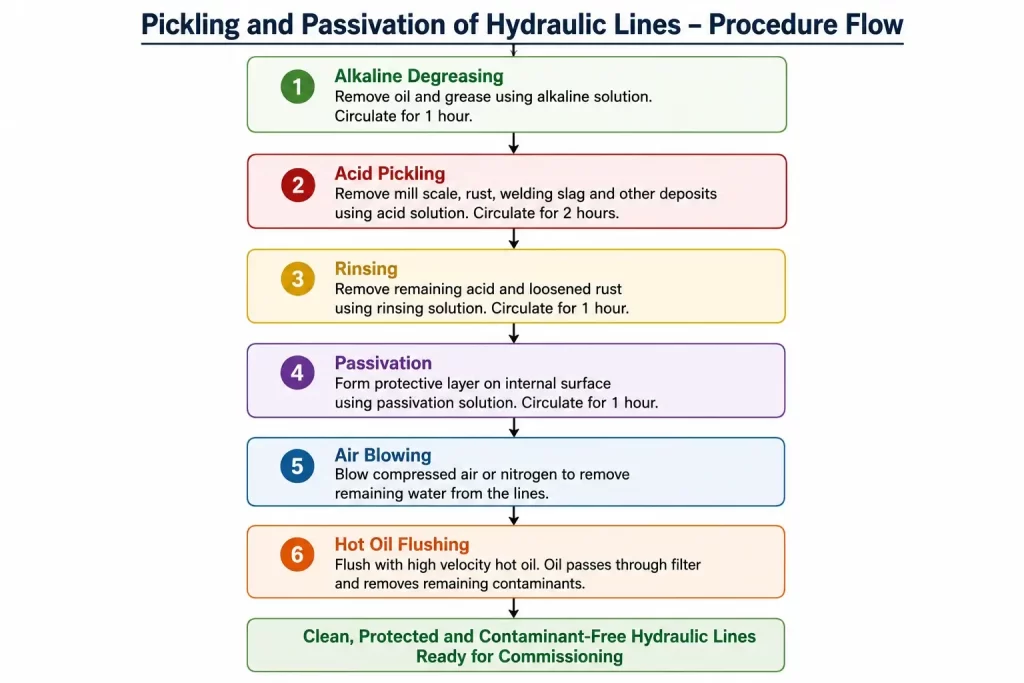
Let’s understand each stage.
PHASE-I: ALKALINE DEGREASING
Chemical Used: Caustic Soda (Caco3)
Ratio: 1:6 (Caustic Soda: Water)
Time of Circulation: 1 Hour
Add Caustic Soda to water in 1:2 ratio & circulate into the pipelines for 1 Hour to remove Grease and Oil film which are present in the pipelines. After circulating for 1 Hour observe the pH factor of the solution which is circulating in the pipelines by placing Litmus paper it has to appear 10 (i.e Blue Colour).
After taking pH value add water to the same solution to bring back Alkali factor of the solution to Neutralization factor (i.e. from pH Value 10 to pH value 7).
PHASE-II: ACID PICKLING
Chemical Used: HCL (33% Concentrated)
Ratio: 1:8 (HCL: Water)
Time of Circulation: 2 Hours
Add HCL solution to water in ratio 1:3 & circulate into the pipelines for 2 Hours toremove Mill Scales, Welding Slag, Iron oxide, sometimes siliceous impurities and other extraneous matters. After circulating for 2 Hours observe the pH factor of the solution which is circulating in the pipelines by placing Litmus paper it has to appear 2 ( i.e Pink Colour).
After taking pH value add water to the same solution to bring back Acidic factor of the solution to Neutralization factor (i.e from pH Value 2 to pH value 7).
PHASE-III: RENSING
Chemical Used: Citric Acid
Ratio: 1:5 (Citric Acid: Water)
Time of Circulation: 1 Hour
Add Citric Acid solution to water in ratio 1:5 & circulate into the pipelines for 1 Hour to remove rust from the pipelines after pickling & neutralize process. After circulating for 1 Hour observe the pH factor of the solution which is circulating in the pipelines by placing Litmus paper it has to appear 2 ( i.e Pink Colour).
After taking pH value add Caustic soda to the same solution to bring back Acidic factor of the solution to Alkali factor (i.e from pH Value 2 to pH value 10).
PHASE-IV: PASSIVATION
Chemical Used: Sodium Nitrate (NaNo3)
Ratio: 1:5 (Sodium Nitrate: Water)
Time of Circulation: 1 Hours
Add Sodium Nitrate to the Alkali solution (i.e after Rensing process) in the ratio 1:5 to form a thin layer of Gamma Ferric Oxide inside the pipeline. The layer is formed under expansion and hence is passive and protective.
PHASE-V: AIR BLOWING
Blow the compressed air/Nitrogen gas into the pipelines to remove the water particles from the Pipelines.
PHASE-VI: HIGH VELOCITY HOT OIL FLUSHING
Connect the pressure line of flushing unit to one end of pipeline and another end of pipe to return line of flushing unit, then start flushing unit. Adjust the system pressure & flow to generate high velocity (i.e Turbulent Flow), then this high velocity oil will remove scale and particulate from the piping and flush it back to the system where it will be filtered ( i.e Return Line Filter of Flushing unit). By placing On-Line Laser Particle Counter measure, the NAS value of Hydraulic oil which is circulating in the pipeline to know the cleanness of oil.
Temporary Circulation Loop for Pickling
A temporary circulation arrangement is normally established before starting the chemical cleaning process.
The supplied procedure calls for a temporary connection consisting of a motor-pump set, tank and hoses.
The hydraulic pipeline is arranged as a closed loop.
The basic arrangement can be understood as:
Tank → Pump → Hydraulic Pipeline → Return Line → Tank
The solution is continuously circulated through the pipeline during each cleaning stage.
Care should be taken while making temporary flange connections because leakage during chemical circulation can create both safety and equipment risks.
Safety Precautions During Pickling and Passivation
Safety is one of the most important aspects of pickling and passivation because chemical cleaning involves acids and alkaline chemicals.
Workers involved in the activity should use appropriate personal protective equipment, including:
- Safety shoes
- Chemical-resistant gloves
- Eye protection
- Suitable protective clothing
- Appropriate respiratory protection where required by the site’s chemical safety assessment
The supplied procedure specifically highlights eye care, breathing protection, skin protection, work-area precautions, warnings, first aid and appropriate clothing.
Other important precautions include:
Complete welding and cutting before chemical cleaning
No drilling, welding or cutting should be carried out during the pickling process.
Isolate sensitive components
Valves, fittings and other components that are not suitable for the chemical cleaning circuit should be removed or replaced with appropriate temporary connections. Non-ferrous components that could be affected by the chemicals should not remain in the circuit.
Check the temporary connections
Temporary joints should be properly tightened and checked for leakage before starting circulation.
Ensure chemical compatibility
The exact chemicals, concentration, temperature, circulation time and neutralization procedure should always follow the approved project procedure and chemical supplier requirements. The values in the supplied procedure should not automatically be applied to every hydraulic system.
Common Contaminants Found Inside Hydraulic Pipelines
During fabrication and installation, several types of contamination can enter a hydraulic pipeline.
1. Mill Scale
Mill scale is formed during the manufacturing and hot-working of steel. It can remain attached to the internal surface and later become a source of contamination.
2. Welding Slag
Welding and fabrication activities can leave slag, welding debris and other residues inside the pipe.
3. Rust
Moisture exposure during storage or installation can cause internal rust formation.
4. Oil and Grease
Handling and fabrication activities can leave oil and grease inside the piping. These are targeted during the alkaline degreasing stage.
5. Dirt and Foreign Particles
Dust, metal particles and other debris can enter open pipe ends during transportation and installation.
The purpose of pickling and passivation is to systematically deal with these contaminants before the hydraulic system is placed into service.