
The efficiency of CHP is depending upon availability and reliability of conveyor belt system. A single conveyor can run at close to 100% reliability, but as the number of conveyor increases, the reliability of the conveyor belt system is mostly depend upon its control system. The control system has sensing device like zero speed sensing, receiving conveyor position sensing. It has also facility for selection to operate conveyor avoiding control system i.e. manual run mod. In some CHP there is facility of three type of selection. One is for start or stop plant with auto mode. In this mod each conveyor will operate sequentially after selecting the stream. Second which is in all CHP for start or stop of plant with manual mod. Third is operating the system without any protection or interlock.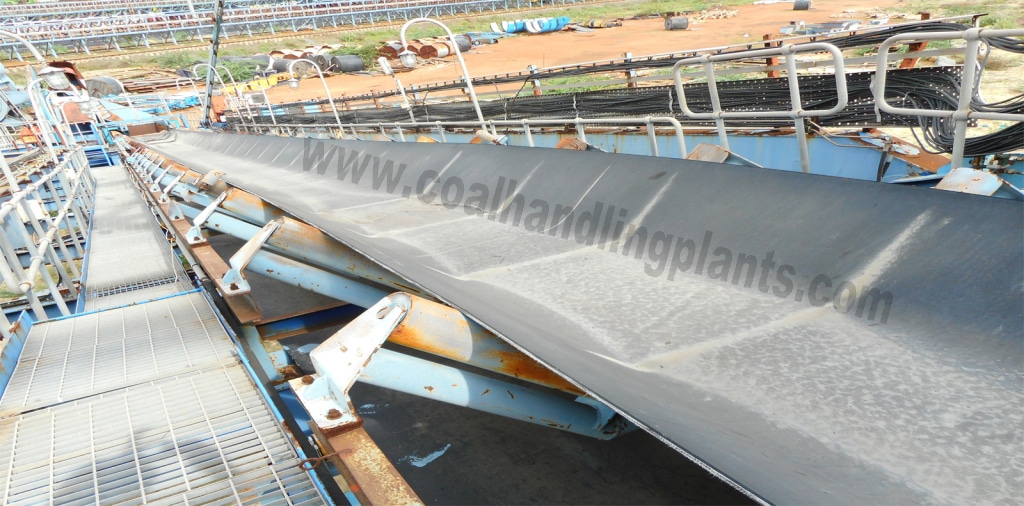
Operating Principle Of Industrial Conveyor Belt System
▶️ Start Sequence: Before the system begins, the receiving (downstream) conveyor must start first, then upstream conveyors in reverse order.
⏹️ Stop Sequence: When shutting down, upstream conveyors stop first, followed by downstream – this ensures no material is stranded in the system.
🚨 If any conveyor slows or stops (zero speed condition), the system triggers a trip, and all upstream conveyors shut down sequentially. This protects against belt damage and prevents material pile-up.
💦 A dust suppression spray system is typically tied to material flow. It activates only when both conditions are met:
a) a mechanical under-belt switch senses material flow,
b) the conveyor motor is running.
This dual condition prevents unnecessary spraying when the belt is stopped but coal remains on it.
⚖️ Coal flow measurement is done using load cells, allowing more precise control of feed rates and efficient plant operation.
Key Components of Industrial belt Conveyor :
1. Rubber Belt
The endless belt carries material from one point to another. It loops over pulleys and idlers under tension.
2. Conveyor Pulley
Following types of conveyor pulleys are used in conveyor belt system
(a) Drive Pulley :
Head/Drive pulley is located at a discharge terminus of the conveyor. It provides the driving force for the conveyor. In order to increase pulley life and traction, it often has a larger diameter than other pulley. Different patterns of grooving such as herringbone or diamond can be provided to increase tractive friction under dirty and wet conditions.Diamond grooves have the advantage of being installed in any orientation, regardless of belt direction.
(b) Snub Pulley :
They are provided to increase warp/contact angle of conveyor belt on nearby head/drive pulley.
(c) Take-up Pulley :
Pulley which can moved to keep belt tight is called take up pulley. It adjusts belt tension to maintain proper tracking.
(d) Bend Pulley :
The bend pulley is used for changing the direction of the belt either 180 degree or 90 degree.
(e)Tail Pulley :
Tail Pulley is provided at the tail end of the conveyor belt.
3. Continuous Weighing Devices
They are used for measuring the load being carried by the conveyor belt.
4. Conveyor Belt Roller / Idlers
These are nothing but rollers, which support to the conveyor belt and these can rotate in any direction. The idlers are also divided into various types depending upon their requirement, Such as;
(a) Impact Idler or Impact Roller :
It is placed at those locations where the coal is falling directly from a higher point through the hopper. It absorbs the Impact.
(b) Self-Cleaning Idler :
It is designed in a screw format so that it can automatically clean the belt and it is placed in the return path of the belt.
(c) Adjusting Idler :
It is designed in such a way that it can adjust the belt sway while running.
(d) Flat Idler or Flat Roller :
It is a normal idler which only supports the belt while running.
(e) Snub Idler or Snub Roller:
It is located at those locations where the conveyor belt changes its direction. Where ever the conveyor belt changes its direction, snub idlers are placed
(f) Troughing Idlers / Troughing roller:
They are found on the carrying-side, along the length of the conveyor. On any particular conveyor these idlers are identical, as are the bases. The troughing idlers comprise a center idler roll of a defined width, and ‘wing’ idlers on either side of the center roll. Unlike the center, horizontal roll, the wing idlers are cranked up to an angle known as the troughing angle
This troughing angle ensures that the carrying belt maintains the same cross-sectional area throughout the carrying strand, so that the load-bearing capacity of a particular conveyor belt is the same along the conveyors’ full length. Troughing idlers can comprise 3-roll or 5-roll idler sets. The 5-roll idler configuration offers a more uniform cross-section which results in a greater net carrying capacity for the same belt width and belt speed.

(g) Garland Idlers or Garland Roller :
The garland idler set comprises either 3-roll or 5-roll idlers joined together at the ends of their respective shafts by special lugs, to form a continuous ‘chain’ of idlers. On either end of this ‘chain’, the shafts are connected to an attachment bracket which enables the idler set to be attached to the conveyor stringer structure.
They are used predominantly on yard conveyors, shift-able conveyors, and dump conveyors, etc. where the alignment of the conveyor structure may not be completely correct due to the mobility of the conveyor, or the ground conditions onto which the conveyor structure in founded. The garland idler design is more forgiving than the fixed-base troughing idler, due to its chain-like design which allows the belt center line and idler centers to move relative to the supporting frame.
(h) Transition Idler or Transition roller :
Transition idlers are found at either end of the conveyor, adjacent to the head and tail pulleys. These idler sets comprise standard idler rolls however the bases into which these rolls are fitted, have a smaller troughing angle to that of the rest of the troughing idlers on the conveyor.
The reason for this is that the conveyor belt is flat as it passes over the pulleys, under high tension. As the belt changes its’ form to a full trough of say 35 degrees (i.e. from tail pulley to full trough angle), the belt must be supported through this transition zone. If the belt was fed directly into a full trough from the tail pulley, the belt edges would be over-stressed and damage would result.
Similarly, as the troughed angle changes to zero at the head- end, transition idlers provide support through the transition zone.The number of transition idlers depends on the trough angle of the conveyor. In the case of a 45 degree trough angle, 2 or 3 transition idler sets would be used at either end of the conveyor.
(i) Return Idlers or Return Roller :
The mass of the return belt is the only load that return idlers are required to support. As such, return idler sets are spaced at two to three times the pitch of their equivalent carrying-side idler sets. Return idler sets usually have one or two rolls per idler set, for similar reasons.
There are of course exceptions to the above, one being where conveyors carry material along the top and bottom strands as would be the case on two-way conveyors. In this case, troughing idlers would be located along the bottom strand as well as the top strand. Flat return idlers comprise 1 or 2 rolls, the 1-roll design being more prevalent.
In the case of a single flat return idler, the idler can be mounted onto two brackets which are secured to either side of the conveyor support structure as seen adjacent. Where return idler sets comprise two rolls, a support frame is required which supports the idler pair and attaches the idlers to the conveyor frame. This 2-roll design forms the return belt into a ‘v’ trough and these return idler sets are referred to a ‘V’ return idlers. The trough angle of the ‘V’ return idler is usually 10 degrees and this feature has been developed to assist with belt training along the return strand.
(j) Training Idlers / Roller or Self-Aligning Idlers / Roller :
In spite of the correct alignment of a conveyor structure and belt splice, it is a common phenomenon for a belt to misalign at times, mainly as a result of incorrect material loading (off center) or in cases where a conveyor is mounted onto a mobile stacker / reclaimer where the fall across the boom causes the belt to move to one side.
In cases where the belt misaligns, severe damage can be done to the belt should the belt rub against a fixed structure, the head chute or conveyor stringers. A solution to belt misalignment can be to install self-aligning idlers sets or training idlers which are able to detect belt misalignment and automatically re-align the belt.There are a number of different types of training idler designs available in the market which can be used on the carrying and return strands of the conveyor.
5.Drive Unit
The drive unit is the powerhouse of a conveyor belt system. It consists of the drive pulley, motor, gearbox, and coupling, all working together to move the belt and material efficiently. The motor provides rotational power, the gearbox reduces speed and increases torque, and the drive pulley transmits motion to the belt through friction. Proper alignment, tension, and maintenance of the drive unit ensure smooth operation, prevent slippage, and extend belt life.
1️⃣ Electric Motor
An electric motor is an electrical machine that converts electrical energy into mechanical energy.
2️⃣ Gear Box
A gearbox is a mechanical method of transferring energy from one device to another and is used to increase torque while reducing speed. Torque is the power generated through the bending or twisting of a solid material.
3️⃣ Coupling
The primary purpose of couplings is to join two pieces of rotating equipment while permitting some degree of misalignment or end movement or both.
Shaft couplings are used in machinery for several purposes. The most common of which are the following.
-
- To provide for the connection of shafts of units that are manufactured separately such as a motor and generator and to provide for disconnection for repairs or alterations.
-
- To provide for misalignment of the shafts or to introduce mechanical flexibility.
-
- To reduce the transmission of shock loads from one shaft to another.
-
- To introduce protection against overloads.
-
- To alter the vibration characteristics of rotating units.
- To connect driving and the driven part.
6. Belt Scrapper
The belt scraper cleans the conveyor belt by removing stuck material, preventing carryback and reducing belt wear. It must be properly adjusted so the rubber blade touches the belt evenly without excessive pressure.
7. Skirt Rubber
The skirt rubber seals the gap between the chute and belt, preventing material spillage. It should hang close to the belt with about 1 mm clearance to avoid friction damage.
8. Conveyor belt safety devices
1️⃣ Pull Cord Switch (Emergency Stop)
A pull cord switch is installed on both sides of the conveyor belt. In case of an emergency, operators can pull the rope to instantly stop the electric conveyor belt.
2️⃣ Belt Sway Switch
The belt sway switch detects any misalignment of the flat conveyor belt. If the belt drifts beyond the safe limit, the switch sends a signal to stop the conveyor, preventing edge damage and material loss.
3️⃣ Zero Speed Switch
This switch monitors the belt speed. If the conveyor slows down or stops unexpectedly, it triggers a trip signal to shut down upstream conveyors, protecting the system from overload and spillage.
4️⃣ Slip Switch
It detects when the drive pulley is rotating but the belt is not moving, indicating belt slippage due to insufficient tension or load. The system then stops automatically to prevent belt wear and fire hazards.
5️⃣ Level Probe / Chute Block Switch
Installed at transfer points and chutes, this switch senses coal buildup or blockage and stops the upstream conveyor to avoid overflow or equipment damage.
6️⃣ Temperature & Fire Sensors 🔥
Used especially in coal mines conveyors, these sensors monitor bearing temperature, drive motor temperature, and detect coal dust ignition risk.
7️⃣ Interlocking System
All safety devices are connected to the PLC-based control system that ensures sequential shutdown in case of any fault.
Common Conveyor Belt Problems and Solutions
Conveyor belt systems in thermal power plants may experience operational problems that affect reliability and coal transportation.
-
Belt Misalignment: Check conveyor structure alignment, idler condition, and proper coal loading.
-
Belt Slippage: Inspect belt tension, drive pulley lagging, and material buildup.
-
Chute Blockage: Check chute condition, coal moisture, and blockage sensors.
-
Excessive Belt Wear: Inspect belt scrapers, idlers, skirt rubber, and loading points.
-
Idler Failure: Check bearing condition, abnormal noise, temperature, and roller rotation.
-
Zero Speed Trip: Inspect the drive unit, belt slippage, speed sensor, and electrical supply.
RELATED SEARCHES:
Conveyor Belt Questions & Answers