
Long-term boiler tube overheating is different from the short-term overheating.
In short-term overheating, the tube can become extremely hot in a short period and fail quickly. In long-term overheating, the tube remains at an excessive temperature for a much longer period. The damage develops slowly, and the tube gradually loses its ability to withstand the operating stress.
This type of damage is commonly associated with superheater, reheater and waterwall tubes.
What Is Long-Term Boiler Tube Overheating?
Long-term boiler tube overheating occurs when a boiler tube operates at a temperature higher than its suitable operating limit for an extended period. The tube may continue to operate without any immediate leakage or visible deformation. However, continuous exposure to high temperature while the tube is under internal pressure gradually affects the material.
The basic sequence is long term boiler tube overheating:
High tube-metal temperature ➜ Long exposure under stress ➜ Gradual loss of material strength ➜ Creep damage ➜ Creep voids and cracks ➜ Tube rupture
The important difference from short-term boiler tube overheating is the time over which the damage develops. A temperature condition that does not cause immediate failure can still become dangerous if it continues for a long period.
What Does Long-Term Boiler Tube Overheating Look Like?
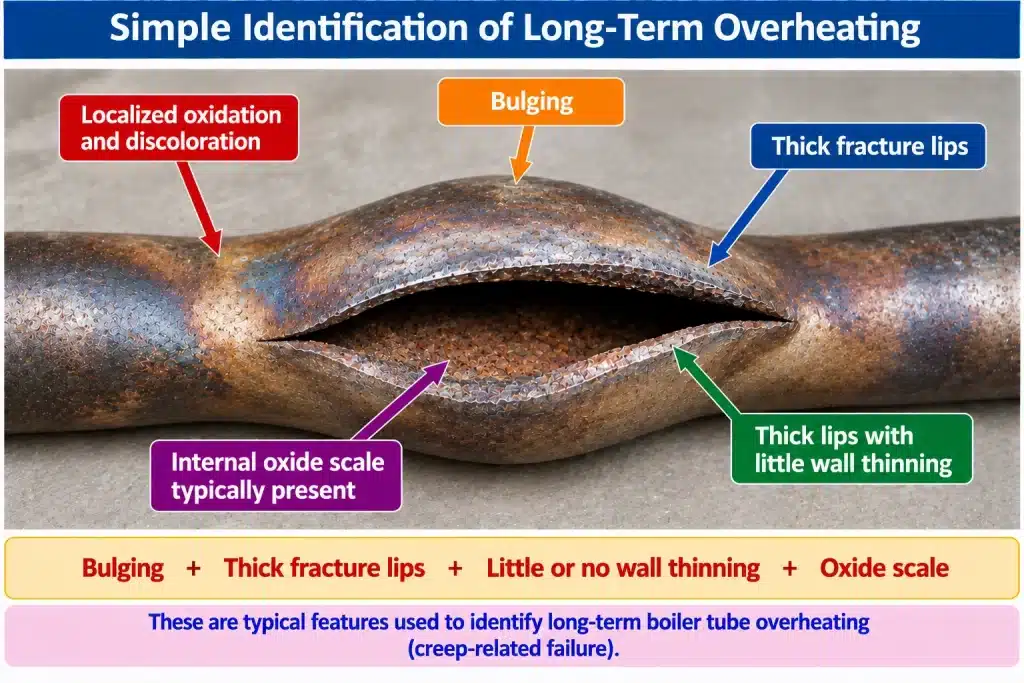
The physical appearance of a long-term overheated tube is generally different from the thin-lip failure associated with short-term overheating. Long-term overheating is commonly associated with a thick-lip fracture.
Typical features can include:
- Thick fracture lips
- Little or no wall-thickness reduction
- Moderate or localized bulging
- Internal oxide scale
- Creep cavities
- Intergranular cracking
- Localized microstructural degradation
Therefore, a combination of bulging + thick fracture lips + little wall thinning + creep evidence can provide an important indication of long-term overheating.
Why Does Long-Term Overheating Occur?
The main problem is usually a gradual increase in tube-metal temperature. This can happen when the tube receives more heat than normal or when the water/steam inside the tube cannot remove heat effectively.
1. Internal Scale or Deposits
Scale or deposits on the inside surface of a tube can act as an insulating layer. As the deposit becomes thicker, heat transfer from the tube metal to the fluid becomes less effective. The tube-metal temperature can therefore increase even when the measured steam temperature does not show a major abnormality.
2. Restricted Water or Steam Flow
A partially blocked tube may not receive sufficient cooling flow. The restriction can be associated with:
- Deposits or scale
- Debris
- Condensate
- Other restrictions in the flow path
When the cooling flow decreases, less heat is removed from the tube and the tube-metal temperature can gradually rise.
3. Excessive or Uneven Burner Firing
Improper burner adjustment can cause some areas of the boiler to receive more heat than others. As a result, a particular tube or tube section may operate at a higher temperature for a long period. This type of localized overheating can occur even when the overall boiler operating parameters appear to be normal.
4. Steam Blanketing
Steam blanketing can occur in certain horizontal or inclined tube arrangements. When effective cooling is reduced, the affected portion of the tube can operate at a higher temperature. If this condition continues, it can contribute to long-term overheating and creep damage.
5. Uneven Flue-Gas Flow
Hot flue gas may not always flow uniformly across the heating surfaces. If hot gases become concentrated around a particular area, that tube section can receive higher heat input than intended. Continuous exposure to this condition can result in localized long-term overheating.
6. Operation Above the Allowable Temperature
Boiler tubes are designed for specific combinations of temperature, pressure and material properties. If a tube operates above its allowable temperature for a prolonged period, the rate of material degradation and creep damage can increase.
What Is Creep and How Does It Damage the Tube?
Creep is the gradual deformation of a material when it remains under stress at high temperature. A boiler tube is continuously subjected to internal pressure. Therefore, the tube wall remains under stress while it is exposed to high temperature. At elevated temperature, the material can slowly deform under this stress. Initially, the damage may be very small and difficult to detect. With continued exposure, however, the material gradually deteriorates.
The process of can be represented simply as:
The creep rate depends on factors such as temperature, applied stress and the strength of the tube material.
What Changes Inside the Tube During Long-Term Overheating?
The material does not remain in its original condition during years of high-temperature service. For carbon and low-alloy steels, the original ferrite-pearlite structure can gradually change during prolonged exposure to elevated temperature and stress.
The progression can be simplified as:
Ferrite + Pearlite → Pearlite starts to degrade → Globular or spheroidized carbides develop → Carbides become dispersed in the ferrite → Carbides accumulate along grain boundaries → Creep voids develop → Voids join and form microcracks → Final stress-rupture failure
With continued damage, important material properties such as strength and hardness can also decrease.
How Is Long-Term Boiler Tube Failure Investigated?
When a tube fails, replacing the damaged section is only the immediate repair. The more important question is:
Why did the tube operate at an excessive temperature for such a long period?
A practical investigation should consider:
Failure Location → Tube Thickness and Deformation → Internal and External Scale → Operating History → Flow Condition → Heat Input → Metallographic Examination → Creep Damage Assessment → Root Cause
For older boilers and high-temperature pressure parts, Remaining Life Assessment (RLA) helps determine the condition of the tubes and estimate their remaining service life. It can include checks such as tube-wall thickness, oxide-scale measurement, metallographic examination, hardness testing, and other inspections to identify material degradation and assess the remaining life of the components.
How Can Long-Term Boiler Tube Overheating Be Prevented?
Prevention mainly depends on keeping the tube-metal temperature within the intended range throughout the service life of the tube.
1. Maintain Proper Water and Steam Flow
Ensure adequate cooling flow through waterwall, superheater and reheater circuits. Any condition that can partially restrict flow should be investigated.
2. Control Internal Scale and Deposits
Proper water and steam chemistry control helps reduce excessive internal deposits and scale. Where high-temperature tubes are concerned, internal oxide formation should also be monitored during inspection.
3. Maintain Proper Burner Operation
Avoid excessive or uneven firing. Proper burner adjustment helps maintain a more uniform heat distribution across the heating surfaces.
4. Monitor Temperature Trends
Do not look only at whether a temperature is within its normal range. A gradual increase or persistent abnormal temperature difference may indicate a developing heat-transfer or flow problem.
5. Inspect High-Temperature Tubes Periodically
Superheater and reheater tubes operating under severe temperature conditions should be periodically checked for:
- Oxide scale
- Wall condition
- Microstructural degradation
- Creep damage
Periodic microstructural examination is specifically discussed in the document as a method of assessing creep damage.
6. Carry Out Remaining Life Assessment
For aging boilers, RLA can help identify creep and other temperature-dependent damage before it develops into an unexpected tube failure.
7. Investigate Repeated Failures
If similar tubes continue to fail, simply replacing the failed tube is unlikely to address the underlying problem. The investigation should look at:
Temperature + Flow + Scale + Heat input + Material condition + Operating history
The aim should be to correct the condition that caused the overheating.
Conclusion
Long-term boiler tube overheating is a slow-developing failure mechanism. The tube may continue operating for a long time, but continuous exposure to high temperature and internal stress gradually reduces its strength and promotes creep damage.
The important signs include thick-lip rupture, little or no wall-thickness reduction, localized bulging, internal oxide scale, microstructural degradation and creep void formation. Preventing this type of failure requires attention to tube-metal temperature, cooling flow, internal scale, burner operation and long-term operating conditions.
When a tube fails, the focus should not be only on replacing the damaged tube. The real objective is to find out why the tube remained at an excessive temperature for a long period and correct that condition before the same problem causes another failure.
Related Boiler Tube Failure Articles :
Boiler Tube Failure: Why Do Tubes Fail Even When Pressure and Temperature Are Normal?
Long-Term Boiler Tube Overheating: Causes, Creep Mechanism & Prevention
Why Does Hydrogen Damage Cause Boiler Tube Failure?