
In a thermal power plant, coal is the primary fuel that drives electricity generation. Before reaching the boiler furnace, coal travels through several stages — unloading, crushing, stacking, reclaiming, and finally, storage in coal bunker located above the boiler feeders.
These coal bunkers serve as a short-term buffer between the Coal Handling Plant (CHP) and the boiler mills, ensuring a consistent and reliable supply of coal for uninterrupted power generation.
The Coal Bunker Quantity & Backup Hour Calculator is a practical tool for power plant engineers to quickly estimate coal quantity inside bunkers and determine available backup hours based on plant consumption.
📊 Coal Bunker Quantity Calculator
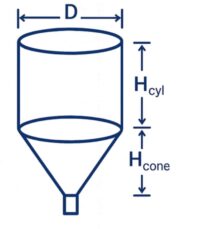
Volume of Cylindrical Portion
The volume of the cylindrical part of a bunker is calculated as:
- Vcyl = Volume of cylindrical portion (m³)
- D = Internal diameter of bunker (meter)
- Hcyl = Height of cylindrical portion (meter)
Volume of Conical Portion
The volume of the conical portion is calculated as:
- Vcone = Volume of conical portion (m³)
- Hcone = Height of conical portion (meter)
Total Volume of Coal Bunker
Total bunker volume is the sum of the cylindrical and conical volumes:
- Vtotal = Total bunker volume (m³)
Total Quantity of Coal (at Full)
By multiplying total bunker volume with bulk density, we get total coal quantity:
- Qtotal = Total coal quantity (ton)
- \(\rho\) = Bulk density of coal (t/m³)
Quantity at Any Empty Level
Let the empty level from the top be \(E\) (meter). The total bunker height is \(H_{tot}=H_{cyl}+H_{cone}\), and the filled height is \(H_{fill}=H_{tot}-E\).
Case A: Empty level within cylindrical portion (E ≤ Hcyl)
The cone is full and part of the cylinder is filled:
Case B: Empty level within conical portion (E > Hcyl)
Only a portion of the cone is filled:
- E = Bunker empty level measured from top (meter). At 0 meter = bunker full.
- Q(E) = Coal quantity remaining at empty level \(E\) (ton).
Backup Time (Hours)
For a single bunker:
For multiple bunkers with quantities \(Q_1, Q_2, \dots, Q_n\):
Frequently Ask Questions (FAQs)
A coal bunker in a thermal power plant is an intermediate storage vessel feeding coal to mills/boiler feeders. Most bunkers are a cylinder on top of a cone. Because the cross-sectional area changes sharply in the cone, quantity does not vary linearly with level—hence the need for geometry-based calculations.
Typical crushed coal bulk density ranges 0.75–1.2 t/m³, but it varies with moisture, particle size, ash, compaction, and blending. For best accuracy, use a site-specific value from sampling or belt scale reconciliation.
Use the current average feed rate to mills/boiler, not the contractual or nominal value. If load is changing, consider a conservative higher TPH to avoid overstating backup hours.
Yes. Higher moisture increases bulk density (more tons per cubic meter), but may also cause bridging, creating voids and misleading level readings. Watch for erratic trends and adjust ρ accordingly.
1. Entering outer instead of internal diameter
2. Using nominal density instead of current blend’s density
3. Confusing empty level from top with filled height
4. Forgetting that 0 meter = bunker full