
A coal-fired thermal power plant generates a large quantity of ash during combustion. This ash is produced mainly as bottom ash and fly ash, along with coarser ash collected from areas such as the economizer and air pre-heater.
The Ash Handling System is an essential auxiliary system of a thermal power plant used for the collection, cooling, conveying, storage, disposal and, where applicable, utilization of ash.
Depending on the plant design, ash may be handled by wet, dry, slurry, pneumatic or combined systems.
A properly designed ash handling plant ensures reliable ash evacuation, safe operation of the boiler, controlled disposal and efficient use of water and energy.
Types of Ash Generated in Thermal Power Plant

- Bottom Ash – Ash generated below furnace of the thermal power plant is called the bottom ash. The value of bottom ash generated is around 20 % of total ash. Bottom ash is mostly coarse in nature hence it needs to be further crushed before being transported to ash handling system.
- Fly Ash – Around 80 % of ash generated in thermal power plant is fly ash. It is in form of very fine particles which is collected via economiser hopper, air-preheater hopper and electrostatic precipitator (ESP).
What is ash handling plant or ash handling system?
An Ash Handling System (AHS) or Ash Handling Plant (AHP) is a system used to:
- collect ash generated during coal combustion,
- cool hot bottom ash,
- crush large ash clinkers,
- convey ash from different collection points,
- store ash temporarily,
- transport ash to an ash pond, ash dyke, silo or disposal area,
- recover and reuse water where a wet system is used, and
- facilitate safe and controlled operation of the ash disposal system.
The exact arrangement depends on the boiler design, coal characteristics, ash quantity, environmental requirements and the selected ash-disposal technology.
Layout of Ash Handling Plant or Ash Handling System in Thermal Power Plant

Main Sections of an Ash Handling Plant
A typical ash handling plant can be divided into:
- Bottom Ash Handling System
- Fly Ash Handling System
- Coarse Ash Handling System
- Ash Slurry Disposal System
- Ash Water System
- Ash Water Recovery System
- Fly Ash Storage and Disposal System
- Electrical and Control & Instrumentation System
Bottom Ash Handling System
The Bottom Ash Handling System removes ash from the bottom of the boiler furnace.
There are different technologies for bottom ash handling, mainly:
- Wet bottom ash handling
- Dry bottom ash handling
1. Wet Bottom Ash Handling
In a wet system, hot bottom ash is collected in a water-filled or water-impounded hopper. A typical arrangement is:
Furnace → Water-Impounded Bottom Ash Hopper → Clinker Grinder → Jet Pump → Ash Slurry Sump
The water cools the hot ash and allows it to be transported as slurry.
2. Dry Bottom Ash Handling
In a dry system, bottom ash is removed without converting the entire ash stream into a water slurry. A typical arrangement may include:
Furnace → Transition Hopper → Bottom Ash Valve → Dry Bottom Ash Conveyor → Crushers → Clinker Cooling Conveyor → Bottom Ash Silo
The dry system can use air for cooling and mechanical equipment for conveying and crushing the ash.
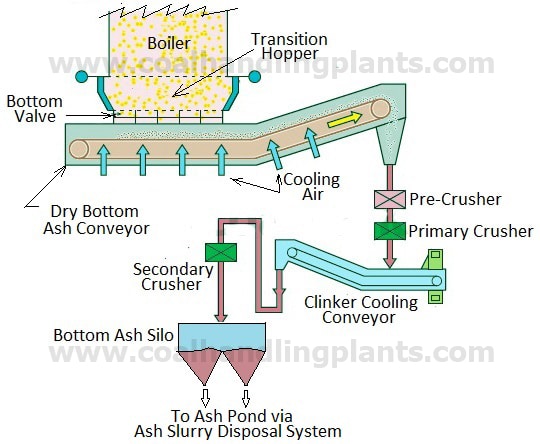

The choice between wet and dry technology depends on plant design, water availability, ash characteristics, environmental requirements and disposal philosophy.
Fly Ash Handling System

Fly ash is collected from the flue-gas path, particularly from ESP and duct hoppers. It generally requires a different conveying system from bottom ash because of its fine particle size. A typical fly ash route is:
ESP Hoppers → Vacuum Conveying → Collector/Buffer Hopper → Wetting Unit or Silo → Disposal/Utilization
In a wet system, fly ash is mixed with water to form slurry.
In a dry system, fly ash is conveyed to silos for storage and subsequent transportation or utilization.
Coarse Ash Handling System
Coarse ash collected from the Economizer and Air Pre-Heater hoppers. Because of its relatively coarse nature, it can be handled separately from fly ash.
Ash Slurry Disposal System
In wet ash handling systems, ash is mixed with water to form ash slurry. The slurry is collected in an ash slurry sump and transported to the disposal area. Depending on the plant design, HCSD or lean slurry disposal may be used.
1. High Concentration Slurry Disposal (HCSD)
Ash slurry is transported to the disposal area using ash slurry pumps and dedicated slurry pipelines.
Ash Slurry → Slurry Sump → Slurry Pump → Disposal Pipeline → Ash Disposal Area
2. Lean Slurry Disposal

Ash slurry is conveyed to a dewatering bin, where water is separated from the ash. The dewatered ash may then be transported to the disposal area by truck. The separated water is sent to a sedimentation tank or pond for clarification and may be reused in the ash handling system.
Ash Slurry → Dewatering Bin → Dewatered Ash → Ash Disposal Area
The ash slurry sump may receive slurry from the bottom ash, coarse ash and wet fly ash systems, along with applicable overflow and drain streams
Ash Water System
Water is an important utility in a wet ash handling plant. The Ash Water System supplies water to equipment such as Jet pumps, Wetting units, Ash slurry systems, Sealing arrangements, Jetting nozzles, Other water-consuming equipment
Depending on the plant design, the system may include HP water pumps, LP water pumps, Seal-water pumps, Ash-water sump, Makeup-water system, Water pipelines and valves
Ash Water Recovery System
Wet ash handling can consume a significant amount of water. The Ash Water Recovery System is therefore provided in suitable plant configurations to recover water from the ash handling process and return it for reuse. A simplified arrangement is:
Ash Handling Area → Water Recovery → Storage → Ash Water Sump → Reuse
The main objective is to:
- Reduce fresh-water consumption
- Improve water utilization
- Reduce wastewater generation
- Support continuous wet ash handling
Fly Ash Storage and Disposal System
Dry fly ash is commonly stored in fly ash silos before transportation or utilization. A typical arrangement is:
Fly Ash Collection → Conveying → Buffer Hopper → Fly Ash Silo → Tanker / Railway / Utilization
A silo may include Fluidizing system, Level measurement, Vent filter, Rotary feeder, Telescopic chute, Drainage arrangements, Access and maintenance facilities.
Electrical and Control & Instrumentation System
The electrical and C&I systems provide power, control, monitoring, protection and automation for the ash handling plant. Important C&I functions include monitoring Hopper level, Sump level, Water pressure, Slurry pressure, Flow, Motor status, Valve position, Equipment alarms, Equipment trips. PLC-based systems can control equipment, interlocks and sequencing.
Common Ash Handling Plant Problems
Typical operational problems include:
1. Bottom Ash System
Hopper choking, Clinker grinder jamming, Feed gate problems, Conveyor problems, Crusher overload.
2. Jet Pump System
Low HP-water pressure, Nozzle blockage, Low conveying performance, Pipeline choking.
3. Slurry System
Slurry pump vibration, High slurry concentration, Pipeline choking, Pipeline wear, Leakage.
4. Fly Ash System
ESP hopper blockage, Vacuum conveying problems, Buffer hopper high level, Silo high level, Vent filter problems.
5. Water System
Low water pressure, Pump failure, Leakage, Inadequate makeup water, Water recovery problems
RELATED SEARCHES:
Introduction of thermal power plant
Introduction of coal handling plant