
Muff Coupling / Sleeve Coupling is the simplest type of rigid coupling, consists of a hollow cylinder whose inner diameter is same as shaft. It is fitted over the ends of the two shafts by means of a gib head key. The power is transmitted from one shaft to the other shaft by means of a key and a sleeve or muff.
Design Of Muff Coupling / Sleeve Coupling
-
Design of Sleeve or Muff
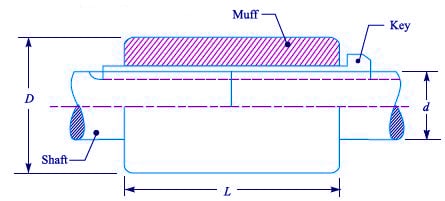

The sleeve or muff is designed by considering it as a hollow shaft.The diameter and length of sleeve is calculated by using below mention formula:
Outer diameter of the sleeve, D = 2d +13
Length of the sleeve, L = 3.5d
Where d is the diameter of the shaft.
The induced shear stress in the sleeve or muff is checked by using below mention expression:
-
Design for key
The length of the coupling key is equal to the length of the sleeve. The coupling key is usually made into two parts so that the length of the key in each shaft.
Key Length, l = L / 2 = ( 3.5 x shaft dia ) / 2
After fixing the length of key in each shaft, the induced shearing and crushing stresses are checked by using below mention expression:

Working Principle of Muff Coupling
A muff coupling works on the principle of friction and key-based torque transmission:
- Shafts are aligned coaxially.
- Key halves are inserted into the keyways.
- The sleeve is slid over the shaft ends and keys.
- Torque transfers from:
Driving shaft → Key → Sleeve → Key → Driven shaft
Because there are no moving parts, the coupling is highly reliable for continuous-duty applications.
Advantages of Muff / Sleeve Coupling
- Simple and economical design
- Compact structure
- High torque transmission capability
- Easy to assemble and maintain
- Suitable for aligned shafts
- No lubrication needed
- Good for medium-speed applications
Limitations of Muff Coupling
- Cannot tolerate misalignment
- Removal requires shifting one shaft
- Not suitable for high-speed vibration-prone systems
- No overload protection
Preventive Maintenance of Muff Coupling
Regular inspection helps maintain reliable torque transmission and reduces the risk of unexpected failure.
- Check the sleeve for cracks, corrosion, and visible damage.
- Inspect the key and keyway for wear, deformation, or looseness.
- Verify shaft alignment according to the equipment manufacturer’s tolerances.
- Check for abnormal noise and vibration during operation.
- Inspect the coupling fasteners or retaining arrangements, where applicable.
- Replace damaged keys or sleeves with components of the correct dimensions and material.
- Ensure the coupling guard is properly installed before restarting the equipment.
Safety: Isolate the driving equipment and follow the plant’s lockout/tagout procedure before inspecting or dismantling the coupling.
RELATED SEARCHES: