
In a thermal power plant, maintaining a high vacuum in the steam condenser is essential for efficient turbine operation and improved heat rate. This is achieved using vacuum pumps, which evacuate air and non-condensable gases from the condenser. By keeping condenser pressure low, vacuum pumps increase turbine efficiency, reduce backpressure, and save fuel.
The most widely used design in power stations is the liquid ring vacuum pump, due to its reliability, ability to handle wet gases, and continuous-duty performance
Role of Vacuum Pumps in Power Plants
A steam turbine condenser is designed to operate under vacuum (typically 0.09–0.1 bar abs). Any leakage of air into the system reduces efficiency and can damage equipment. Vacuum pumps serve two main purposes:
- Hogging Operation – Quickly evacuating large volumes of air from the condenser during turbine start-up.
- Holding Operation – Continuously removing small amounts of air and gases that leak into the condenser during steady operation.
By performing these two functions, vacuum pumps ensure reliable condenser performance and optimal turbine efficiency
Working Principle of Liquid Ring Vacuum Pumps
A liquid ring vacuum pump operates on a simple but effective principle:
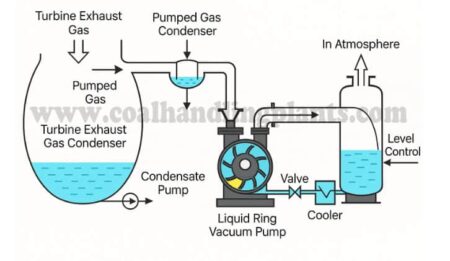
- A rotor with vanes is mounted eccentrically inside a casing partially filled with water (seal liquid).
- As the rotor spins, the water forms a liquid ring, creating chambers of varying volume between the vanes.
- Gas enters during the expansion phase, is compressed as the volume reduces, and is expelled at discharge.
- Seal water also condenses vapor, improving vacuum generation efficiency .
This design is rugged, tolerant of liquid carryover, and ideal for wet steam environments in condensers.
System Design – Liquid Ring Vacuum Pump Package
A standard condenser air removal package includes:
- Two liquid ring vacuum pumps (one duty, one standby).
- Motor drive (directly coupled).
- Seal water separator to remove entrained gases.
- Plate heat exchanger to control seal water temperature.
- Recirculation pump for seal water loop.
- Filters, strainers, and piping to maintain water quality.
- Instrumentation and controls for pressure, flow, temperature, and motor load.
Hogging Mode
- All pumps run in parallel to reduce evacuation time.
- Used during turbine start-up to reach design condenser vacuum quickly.
Holding Mode
- Only one pump runs, with another on standby.
- Automatically switches based on condenser pressure.
Maintenance Practices
Daily Checks
- Monitor vacuum level, motor amps, seal water flow, and cooling water temperature.
- Listen for abnormal noise or cavitation.
Weekly/Monthly
- Inspect filters and strainers, clean as needed.
- Check separator tank level and drains.
- Inspect purge lines and piping.
Annual/Overhaul
- Inspect bearings, seals, and impeller for wear.
- Check alignment of motor and pump.
- Inspect heat exchanger for scaling/fouling.
- Replace worn O-rings, gaskets, and mechanical seals.
Problems in Liquid Ring Vacuum Pumps – Causes & Corrective Actions
Problem 1: Low Vacuum in Condenser
Cause:
- Air leakage into condenser or vacuum piping.
- Insufficient seal water flow or high seal water temperature.
- Fouling in seal water cooler or separator.
- Worn impeller or vane clearances.
Corrective Action:
- Inspect and seal air leak points in condenser tubes, joints, or gaskets.
- Ensure proper seal water flow (as per OEM) and maintain correct temperature (7–11 °C above cooling water inlet).
- Clean or backflush heat exchanger.
- Repair or replace worn rotor/vanes.
Problem 2: Excessive Vibration or Noise
Cause:
- Pump-motor misalignment.
- Bearing wear or imbalance of rotor.
- Cavitation due to low seal water supply.
- Foreign particles in pump casing.
Corrective Action:
- Re-align motor and pump shafts.
- Replace bearings and check balance.
- Ensure seal water is free of air and at correct pressure.
- Flush pump casing, install filters/strainers.
Problem 3: Overheating of Pump
Cause:
- Inadequate cooling water flow to seal water cooler.
- Recirculation water loop not working.
- Prolonged hogging operation at full load.
Corrective Action:
- Check cooling water circuit and clean cooler.
- Inspect recirculation pump operation.
- Shift to holding mode once design vacuum is achieved.
Problem 4: Frequent Motor Trips
Cause:
- Overcurrent due to high pump load.
- Blocked suction/discharge lines.
- High frictional losses from fouled piping.
- Defective pressure or flow transmitters giving false alarms.
Corrective Action:
- Check motor load and compare with design kW.
- Inspect and clean suction/discharge piping.
- Verify transmitter calibration and replace faulty sensors.
Problem 5: Excessive Seal Water Consumption
Cause:
- Leakage in recirculation lines.
- Faulty control valves not throttling properly.
- Worn shaft seals or mechanical seals.
Corrective Action:
- Inspect and repair leaking pipes/valves.
- Service or replace mechanical seals.
- Optimize recirculation loop operation.
Problem 6: Pump Fails to Start or Build Vacuum
Cause:
- Motor electrical fault (starter, relay, supply).
- Insufficient water priming in casing.
- Air binding in suction line.
- Damaged impeller.
Corrective Action:
- Check motor circuit and rectify electrical issues.
- Ensure pump casing is filled with water before starting.
- Vent suction line to release trapped air.
- Replace or repair impeller.
Problem 7: Separator Tank High Level / Water Carryover
Cause:
- Separator drain blocked.
- Faulty level control valve.
- Excess seal water flow entering separator.
Corrective Action:
- Clean separator drains regularly.
- Test and repair level control valve.
- Adjust seal water flow to design limits.
Problem 8: Cavitation in Pump
Cause:
- Insufficient seal water supply.
- Seal water temperature too high.
- Sudden load fluctuation in condenser.
Corrective Action:
- Increase seal water flow.
- Ensure cooler is operating efficiently.
- Stabilize condenser operation, check for sudden air ingress.
Frequently Ask Questions (FAQs) on Vacuum Pump
Because they handle wet gases, tolerate condensate, and provide reliable 24/7 operation.
Hogging quickly removes air at startup; holding maintains vacuum during continuous operation.
Condenser pressure rises, turbine efficiency drops, and a unit trip may occur if pressure crosses safe limits.
Using a plate heat exchanger with cooling water, maintaining water ~7–11 °C above cooling water inlet.
At least once per month, or more frequently in high-dust environments.
Liquid Ring Vacuum Pumps – Most common, robust, handle wet steam and gases, used for condenser hogging and holding.
Steam Jet Ejectors – Use high-velocity steam jets to remove air, common in older plants.
Dry Screw/Claw Vacuum Pumps – Emerging type, oil-free, energy efficient, but less common in large thermal stations.