
In coal handling plants (CHP), tramp metals such as bolts, nuts, spanners, and broken machine parts can accidentally mix with coal during transportation or stockyard reclaiming. If undetected, these metallic pieces can damage crushers, conveyor belts, and bunkers, leading to costly downtime and potential safety hazards.
To prevent such problems, Balanced Coil Type Metal Detectors are widely installed in conveyors at critical locations. They can detect both ferrous metals (iron, steel) and non-ferrous metals (copper, aluminium, brass, stainless steel), ensuring protection of critical equipment and smooth plant operation.
Components of Balanced Coil Metal Detector
A conveyor-mounted balanced coil detector generally consists of:
- Transmitter Coil – Mounted above the conveyor; generates a stable electromagnetic field.
- Receiver Coils – Two coils placed symmetrically below the conveyor and wired in opposite phase.
- Electronic Control Unit (ECU) – Processes coil signals; includes amplifiers, filters, and microprocessor.
- Power Supply Module – Provides regulated DC power to coils and ECU.
- Relay Outputs / Interlock Contacts – Used to stop conveyor or divert coal via PLC/SCADA.
- Alarm & Indication System – Hooter, lamps, or display to alert operators when tramp metal is detected.
- Enclosure & Mounting Frame – Mechanical structure for coil mounting and IP-rated protection for electronics.
Coil Arrangement
- The transmitter coil is installed above the conveyor belt.
- The two receiver coils are installed symmetrically below the belt.
- These receiver coils are wired in opposite phase, so under normal coal flow their signals cancel each other out, creating a zero balance.
- When any metallic object passes, the balance is disturbed → the imbalance is detected by the ECU.
Working Principle of Metal Detector in Coal Handling Plant
A Balanced Coil Metal Detector works on the principle of electromagnetic induction and zero-balance detection. It uses one transmitter coil (above the conveyor) and two receiver coils (below the conveyor) placed symmetrically and wired in opposite phase. Under normal coal flow, the induced voltages in the receiver coils cancel out, creating a zero balance. When any metal passes through, this balance is disturbed, and the imbalance is detected.
Case 1: No Metal Present
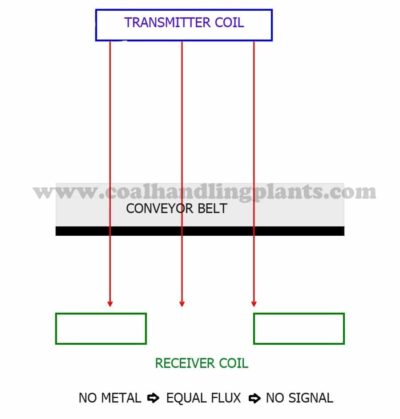
- The transmitter coil generates a stable electromagnetic field across the coal burden.
- Both receiver coils induce equal and opposite voltages.
- These cancel each other, maintaining the zero balance condition.
- ECU records a steady baseline → no alarm, coal flows normally.
Case 2: Ferrous Metal Present
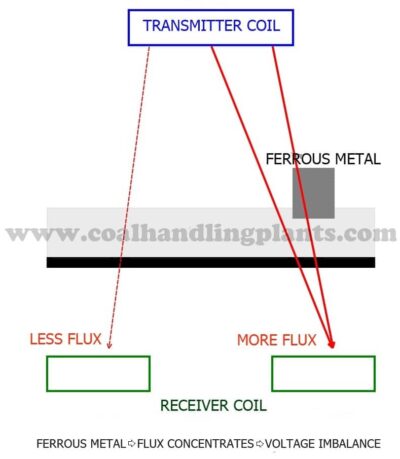
- Ferrous metals (iron, steel) have high magnetic permeability.
- They attract and concentrate magnetic flux lines, breaking the field symmetry.
- One receiver coil senses a stronger induced voltage than the other.
- The imbalance voltage is sent to the ECU.
- ECU amplifies the signal, identifies ferrous tramp metal, and triggers alarm + conveyor interlock/diversion.
Case 3: Non-Ferrous Metal Present
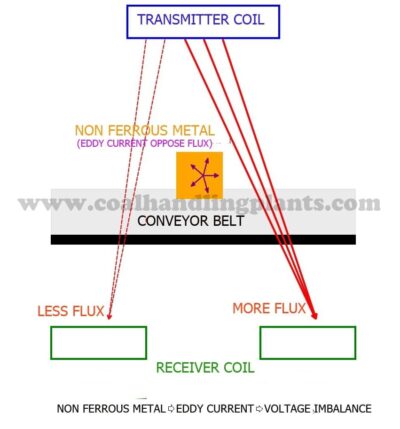
- Non-ferrous metals (copper, aluminium, brass, stainless steel) are good conductors but not magnetic.
- Eddy currents produce their own opposing magnetic field (Lenz’s Law).
- As they pass through the alternating field, they generate eddy currents.
- This repels and distorts the original field, disturbing coil symmetry.
- The receiver coils now sense phase-shifted or altered voltages.
- ECU detects the imbalance and interprets it as non-ferrous tramp metal.
Signal Processing
- The ECU constantly monitors receiver coil signals against the reference zero-balance.
- Any imbalance or phase change is amplified, filtered, and converted into an electrical detection signal.
- If the signal exceeds preset sensitivity, the ECU activates relay outputs, which stop/divert the conveyor and trigger audible/visual alarms.
Installation Metal Detector in Coal Handling Plant
Balanced coil type metal detectors are installed at strategic conveyor points such as:
- After Stacker cum Reclaimer (SCR): To detect tramp metals reclaimed from stockpile.
- Before Crushers: To protect hammers and rotors from metallic damage.
- Before Bunkers (optional): For additional protection.
The coil frame is mounted around the conveyor, while ECU and power unit are placed in a protected control panel. Integration with PLC/SCADA systems allows automatic belt stoppage or diversion when metal is detected.
Advantages of Balanced Coil Metal Detector
- Rugged design, suitable for dusty, humid, and high-vibration CHP environments.
- Detects both ferrous and non-ferrous metals.
- Stable and reliable operation with zero-balance design.
- Protects crushers, conveyors, and transfer points from tramp metal damage.
- Reduces maintenance costs and unplanned shutdowns.
- Improves plant safety by preventing sparks and fire hazards.
Frequently Asked Questions (FAQ) – Balanced Coil Metal Detector
A Balanced Coil Metal Detector is a type of industrial detector that uses one transmitter coil and two receiver coils arranged symmetrically. The receiver coils are wired in opposite phase so that their signals cancel each other when no metal is present (zero balance). Any disturbance caused by tramp metal creates an imbalance, which is detected by the system.
Case I. No Metal: Transmitter generates a magnetic field, receiver coils cancel signals → no detection.
Case II. Ferrous Metal: Disturbs the flux strongly due to high magnetic permeability → imbalance created → detection.
Case III. Non-Ferrous Metal: Generates eddy currents that distort the field → imbalance detected.
They are typically installed:
Before Crushers – to prevent hammer and rotor damage.
After Stacker cum Reclaimer (SCR) – to check stockyard coal.
Optional before bunkers – as an additional safety stage.
Balanced Coil: Works on symmetry/imbalance principle with two receiver coils. Sensitive but can be affected by burden depth.
Pulse Induction: Works by measuring decay of magnetic pulses. More reliable under heavy coal burden, better for deeper metal detection.
1. Simple and cost-effective design.
2. Detects both ferrous and non-ferrous metals.
3. Suitable for standard coal conveyors.
4. Reliable performance under moderate burden depths.
1. Reduced sensitivity when coal burden depth is very high.
2. More prone to false alarms if calibration is poor.
3. Not as effective as PI detectors for large, buried tramp metals.
When tramp metal passes through the conveyor, the ECU detects imbalance and:
1. Triggers an alarm (hooter, lamp).
2. Sends signal to stop the conveyor or divert material via PLC/SCADA.
Yes periodic calibration is necessary to maintain sensitivity, minimize false alarms, and ensure accurate detection of tramp metals