The cable reeling drum is specialized application for power transmission because of severe limitation of tensions in cable.
The cable reeling drum is used to transfer electric power through cable from junction box located at center or end of runway to moving machines.
The cable reeling drum serves winding and unwinding of cable automatically. The winding and unwinding operation of cable is guided through roller guide way.
WORKING OF CABLE REELING DRUM (CRD)
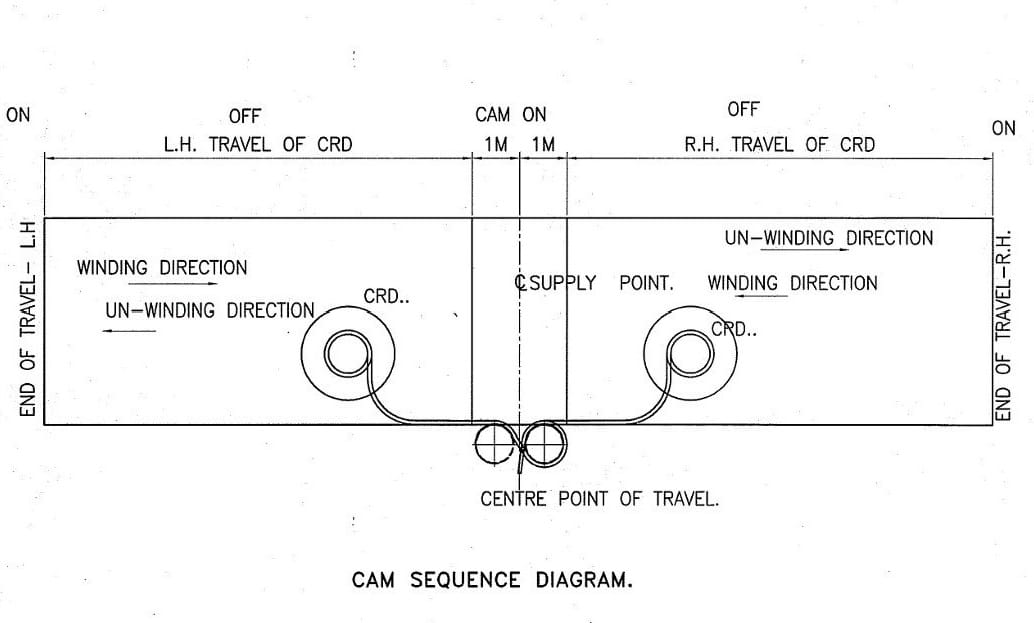
On start of travel motors of the machine, If machine movement is left extremity side from feed point (cable unwinding from drum), RH directional sensor switch will get energies and give signal to main control console of the machine and drive motor of the reel stop on receipt of command from console.
After reaching the machine on left end extremity, end limit switch of the machine will operate and travel drives of the machine stop for the set pulse time and start to operate in reverse direction (to move toward center supply point). Drive unit operate simultaneously and start wounding of cable on drum.
When cable reel comes closer to central feed point, geared rotary switch will get energies and bypassed the under-tension switch in this transition zone. When reel passes the right side of the feed point, the L.H directional sensor will come into operation and stop the reel motor as per set delay time in logic of the program.
On reaching the machine on R.H side extremity, travel drives of the motor will stop as per set pause time in program and then start to operate toward left-hand side. Travel drive of reel also start wounding of reel.
CABLE REELING DRUM CONSIST OF FOLLOWING PARTS
1. Drum Body
The drum design depends on cable diameter and its characteristics. The drum body is made from Rectangular/square hollow section.
2. Drive Units
The drive unit of CRD consists of geared motor with brake and slipping unit used for torque regulating called contorq unit mounted on worm shaft of worm gear box.
The contorq unit is used to provide accurate controlled torque for reeling cables. Adjustment of torque unit is by castellated nut accessed by removing flanged mounted geared motor.
Rotate the nut in clockwise direction to increase and in Anti-clockwise direction to decrease the torque.
Slipring is used to transfer electric power through cable from cable reel to moving machine. The slipring requires well-polished and cleaned surface for good contact. Slipring must be of a size and type sufficient to carry nominated cable current cable current and voltage system. The slipring assembly must be enclosed in a dust proof cover.
4. Roller Guide Ways
The selection of rollers and roller guide depend on cable diameter. In mono-spiral type CRD the roller guide is fixed with crane structure. The rollers of the roller guide should be contoured type to provide an accurate guidance for winding and unwinding of the cable on drum.
The rollers can be rotated on sealed ball bearing protected externally by seals. Individual roller shall be removable without dismantling the guide.
Cable Reeling drum Roller guides supplied with following safety devices, which will protect the cable from external forces.
I.Over Tension Switch
The switch shall be mounted on bottom roller of the guide ways on each side. When cable tension exceeded by 2.3 times the safe pulling tension of cable the switch operates and stops the machine travel motor.
II.Under Tension Switch
The under-tension limit switch intended to detect when drive unit fails to recover the cable properly. While passing center feed point, the function of under tension switch is bypassed the geared rotary limit switch.
III. Directional Sensor Limit Switch (Travel forward And Reverse Switch)
These switches are operated when payoff(unwinding) commences and switch off the drive motor of the reel. It should be operated in any one direction along travel of machine. When machine travel in right direction from feed point, then left directional should be in operating condition and when machine travel in left direction then right directional should be in operating condition.
IV. Geared Rotary Limit Switch
Its function to detect limit of travel of cable reel at each end extremities and to by passed the under-tension switch, when reel passes over the center feed point.
Common Cable Reeling Drum Problems and Solutions
Cable Winding Problems: Check roller guide alignment and drum rotation.
Excessive Cable Tension: Inspect the Contorq unit and torque settings.
CRD Motor Failure: Check the motor, gearbox, and electrical supply.
Slip-Ring Faults: Inspect contact surfaces for wear, dust, and poor connections.
Frequently Asked Questions (FAQ) on Cable Reeling Drum (CRD)
Q1. What is the purpose of a cable reeling drum?
A cable reeling drum (CRD) is used to automatically wind and unwind power or control cables while supplying electricity to a moving machine such as a stacker, reclaimer, or crane. It ensures continuous power transmission without manual handling of cables and protects the cable from mechanical damage.
Q2. How does a cable reeling drum work?
1. When the machine moves away from the feed point, the cable unwinds from the drum. 2. When the machine returns, the drum motor starts winding the cable back automatically. The entire operation is controlled through directional sensors, tension switches, geared rotary limit switches, and the Contorq torque unit that maintains proper tension in the cable.
Q3. What is a Contorq unit in a cable reeling drum?
The Contorq unit is a torque-regulating slipping clutch used in the drive system of a CRD. It ensures a constant and smooth torque during cable winding and unwinding, preventing cable over-tensioning or slack. Torque can be adjusted using a castellated nut — clockwise to increase, and anti-clockwise to decrease.
Q4. What are the main parts of a cable reeling drum?
A typical CRD consists of the following major components: 1. Drum Body – For winding/unwinding cable. 2. Drive Unit – Geared motor with Contorq torque limiter. 3. Slip Ring Assembly – For transferring electric current. 4. Roller Guide Ways – For guiding the cable accurately during reeling. 5. Safety Devices – Over-tension, under-tension, directional, and rotary limit switches.
Q5. What is the function of a slip ring in a CRD?
The slip ring assembly allows electrical power to pass from the stationary junction box to the rotating drum and cable. It ensures uninterrupted power transfer during drum rotation. The slip ring must have a clean, smooth surface and be enclosed in a dustproof housing to maintain efficient electrical contact.
Q6. What is the difference between over-tension and under-tension switches?
The over-tension switch prevents excess pulling force on the cable by stopping the travel motor when tension exceeds the safe limit. The under-tension switch ensures that the cable is properly rewound onto the drum and stops the system if slack or failure to retrieve cable occurs.
Q7. What is a geared rotary limit switch and its function?
A geared rotary limit switch (GRLS) monitors the rotation and position of the cable reel. It detects the end limits of cable travel and also bypasses the under-tension switch when the drum passes over the central feed point, ensuring smooth transition and safe operation.
Q8. Where are cable reeling drums used?
Stacker cum reclaimers, Cranes and conveyors, Ship unloaders, Transfer cars and trolleys
Q9. How to maintain a cable reeling drum for long life?
1. Keep the slip ring surface clean and polished. 2. Regularly inspect cable insulation and roller guides. 3. Ensure proper tension adjustment using the Contorq unit. 4. Periodically check limit switches and sensors for functionality. 5. Lubricate moving parts as per manufacturer’s recommendation.