
When coal burns inside a boiler, not all the carbon burns completely. Some portion remains unburned and is carried away with the fly ash. This is where a coal carbon analyzer becomes important. It helps identify how much carbon is left in the ash, which directly affects ash management and overall plant efficiency. Too much unburned carbon in ash indicates poor combustion, resulting in fuel wastage and reduced efficiency.
The On-Line Carbon-in-Ash Analyzer is an advanced system that continuously measures the amount of unburned carbon present in fly ash while the plant is in operation. It is called “on-line” because it works automatically and continuously without requiring manual sampling.
This analyzer is typically installed near the Electrostatic Precipitator (ESP) or Gas Air Heater (GAH) hopper, where it directly monitors the ash and transmits real-time data to the control room.
By using this data, the operator can:
- Adjust air or fuel for better combustion
- Reduce fuel wastage
- Improve boiler efficiency
- efficiency
✅ In short:
It’s a device that tells how well the coal is burning in the boiler by measuring how much carbon (unburned fuel) is left in the ash — and it does this automatically, all the time.
Working Principle of Online Carbon Analyzer for Fly Ash
The analyzer operates on the microwave frequency measurement principle. Ash from the hopper is transported into a closed measuring chamber by a motor-driven auger. Inside this chamber, the analyzer measures the resonance frequency, which changes according to the amount of unburned carbon in the sample. By comparing this signal with reference data obtained during calibration, the system determines the percentage of unburned carbon in the fly ash.
Measurement Sequence
- Ash Sampling:
A screw auger draws fly ash from the hopper into a closed measurement chamber. - Measurement:
The system generates high-frequency microwaves and measures the resonance frequency of the ash sample.
Since carbon affects the microwave signal, the analyzer calculates the unburned carbon percentage based on this frequency shift. - Data Transmission:
The measured carbon content is converted into a 4–20 mA output signal and sent to the Distributed Control System (DCS) for display and logging. - Discharge:
After each cycle, the auger reverses and compressed air pulses remove the measured ash, preparing the chamber for the next sample.
Each measurement cycle takes 2 to 10 minutes, depending on ash flow and process conditions.
System Components of Online Carbon Analyzer
The Online Carbon Analyzer for fly ash consists of the following key components:
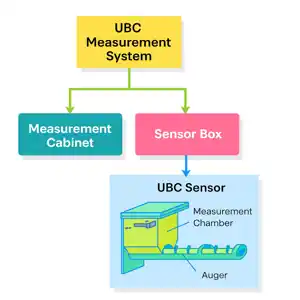
1. Measurement Cabinet
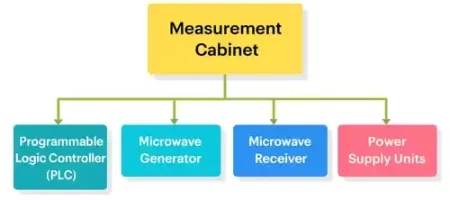
- Contains the control system, programmable logic controller (PLC), and human–machine interface (HMI).
- Displays real-time data, fault messages, and system status.
- Provides 4–20 mA output signals for data transmission to the plant’s Distributed Control System (DCS).
- Stores measurement records and diagnostic logs for easy maintenance and analysis.
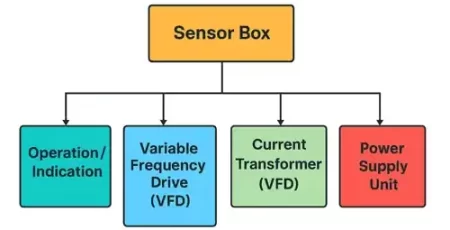
2. Sensor Box
- Installed close to the hopper to minimize signal loss.
- Houses the motor control system, power supply, and communication modules for each sensor.
- Ensures accurate coordination between filling, measuring, and emptying cycles.
3. Sensor Unit
- Mounted directly on the GAH hopper wall.
- Uses a motor-driven auger to feed ash into the measurement chamber.
- Includes a provision for manual sample collection for laboratory comparison.
- Designed with hardened steel construction to withstand the abrasive ash environment.
- Expected service life: Sensor body – 10 years, Auger – 1 year.
4. Pneumatic Unit
- Supplies dry compressed air to clean the sensor and assist in ash removal.
- Ensures smooth operation and prevents material buildup inside the chamber.
Technical Specification
|
Parameter |
Specification |
|
Measurement Range |
0–10 % or 0–20 % carbon in fly ash |
|
Accuracy |
±0.3 % (for 0–1.5 % range), ±0.6 % (for 1.5–10 % range) |
|
Measurement Cycle |
2–10 minutes |
|
Process Temperature |
0–155 °C (downstream of air preheater) |
|
Measurement Type |
Direct on-line measurement |
|
Sample Weight |
~300 grams |
|
Air Requirement |
0.05 Nm³/h at 6 bar pressure |
Role of Online Carbon Analyzer in Ash Management
Efficient ash management depends heavily on the carbon content of fly ash. High-carbon ash has limited use in cement or construction industries, whereas low-carbon ash is in demand for various applications.
The Carbon Analyzer helps in the following ways:
- Ash Quality Control:
Maintains a consistent level of carbon, ensuring fly ash meets industry standards for reuse. - Segregation of Ash:
Enables separation of high-carbon and low-carbon ash for different disposal or utilization routes. - Reduction in Disposal Cost:
Low-carbon ash is easier to handle, store, and transport. - Support for Environmental Compliance:
Reduces ash disposal problems and promotes utilization under ash management policies. - Data-Driven Decisions:
Continuous monitoring supports long-term planning of ash handling, silo management, and ESP hopper operation.
Maintenance And Reliability of Online Carbon Analyzer
The analyzer is designed for long-term, low-maintenance operation.
Routine maintenance involves:
- Checking pneumatic air pressure and filters.
- Verifying calibration using laboratory reference samples.
- Inspecting auger wear and replacing as required.
- Monitoring system alarms or fault messages through the control panel.
The analyzer’s automatic purging system and self-diagnostic features significantly reduce downtime and maintenance costs.
Benefits of Online Carbon Analyzer
- Continuous, direct on-line monitoring of carbon in ash
- Real-time combustion feedback for operators
- No manual sampling or laboratory delay
- High measurement accuracy and reliability
- Minimal maintenance and long service life
- Supports efficient ash utilization and environmental compliance